Lightest model rocket body tube: compare actual tube weights
A tube’s material name won’t tell you what your rocket will weigh. A thin kraft-paper competition tube and a thicker kraft-paper motor tube can have very different masses even when their outside diameters are close. If you’re looking for the lightest model rocket body tube, compare a specific product’s mass per length, then check whether its inside diameter and construction suit the rest of your design.
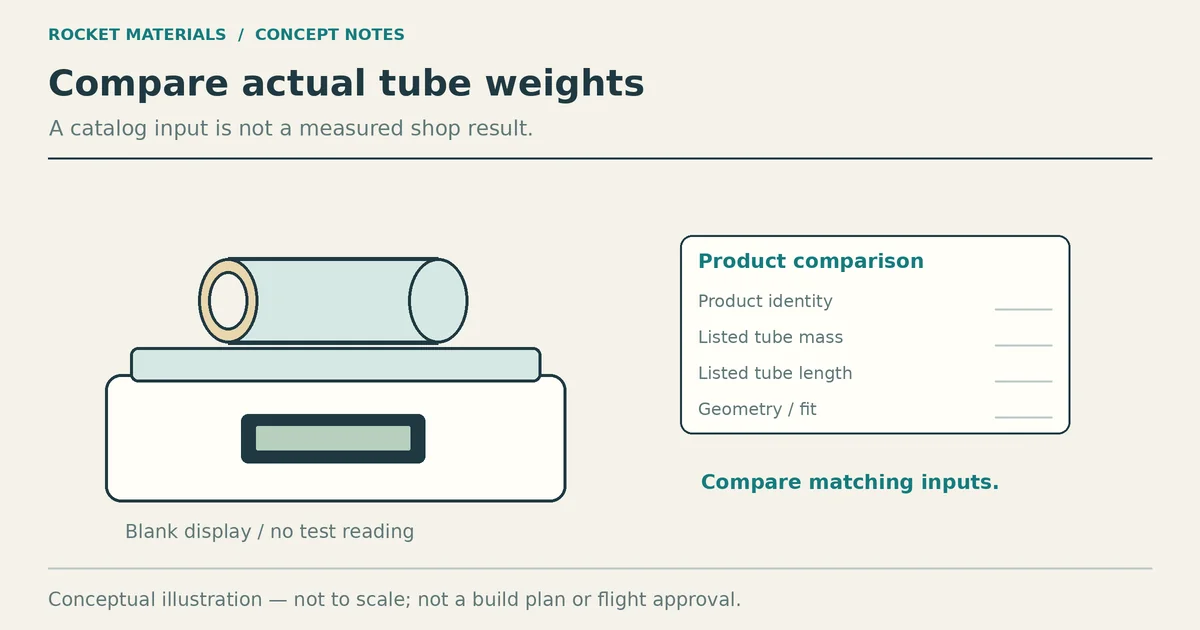
This is a catalog comparison, not a RocketMaterials shop test. The figures below come from named supplier listings, normalized to grams per foot. They do not include glue, paint, couplers, fins or any other rocket parts. Nor do they establish which tube will withstand your particular flight.
A tube-weight comparison you can reproduce
Apogee publishes dimensions, length and weight for each of these products. The weight is for the listed tube, not a measured batch average; some items are sold in multipacks. The last two columns are our calculations: g/ft = listed grams × 12 ÷ listed inches and wall ≈ (OD − ID) ÷ 2. Rounded catalog dimensions mean the derived wall is approximate. Products are ordered by calculated g/ft, but their diameters, walls and lengths are not identical. The first three product listings document the thin paper, BT-60-size paper and clear plastic tubes.[1][2][3]
The other two document LOC and Blue Tube.[4][5]
| Product (supplier model) | Listed material | OD / ID (in) | Approx. wall (in) | Listed tube mass / length | Calculated g/ft |
|---|---|---|---|---|---|
| Apogee 40 mm FAI tube (10139) [1] | Kraft paper, thin wall | 1.595 / 1.575 | 0.010 | 8.6 g / 9.9 in | 10.4 |
| Apogee BT-60-size tube (10141) [2] | Kraft paper | 1.637 / 1.595 | 0.021 | 18 g / 18 in | 12.0 |
| Apogee clear 41.6 mm tube (10144) [3] | Polycarbonate | 1.637 / 1.595 | 0.021 | 41.3 g / 18 in | 27.5 |
| LOC 38 mm tube at Apogee (11005) [4] | Brown kraft paper | 1.635 / 1.525, reseller-listed | 0.055, derived from reseller diameters | 118 g / 34 in | 41.6 |
| ARR 38 mm Blue Tube at Apogee (10501) [5] | High-density fiber/paper | 1.616 / 1.504 | 0.056 | 295 g / 48 in | 73.8 |
The first row is the lightest of these five listed products, not the lightest tube sold anywhere. It’s a thin-wall 40 mm FAI competition tube, with a smaller OD and ID than the BT-60-size paper tube. Do not substitute it for a BT-60 by name: the fit of nose cones, couplers and the recovery bay has to be checked against the actual ID. Apogee describes the FAI tube as a particularly thin kraft-paper product intended for 40 mm FAI competition.[1] The published body tube size chart explains why nominal size labels aren’t universal dimensions.[10]
The closest apples-to-apples comparison here is Apogee’s BT-60-size paper and clear polycarbonate tubes: both list 1.637 in OD, 1.595 in ID and 18 in length. Their catalog weights are 18 g and 41.3 g, respectively, a 23.3 g difference for the listed 18-inch pieces. That’s a comparison of these two SKUs, not a density or strength ranking for all paper and plastic tubes.[2][3] Apogee sells the clear tube as a transparent payload/airframe option; choose it for that function, not as a weight-saving substitute.[3]
The heavier paper row matters, too. Apogee’s listing for LOC-made model 11005 gives a 1.635-in OD and 1.525-in ID, implying an approximately 0.055-in wall; LOC’s own catalog lists the corresponding 1.52-in/38-mm airframe at 1.525-in ID and 0.050-in wall, implying a 1.625-in OD. The listings conflict; do not average them or size a mating ring from either OD without measuring the delivered tube. Its listed weight is still 118 g per 34 in, and the 41.6-g/ft normalization uses that weight and length, not either diameter.[4][7] This is kraft paper, not phenolic. The BT-60-size Apogee paper tube has a listed 0.021-in wall; similar nominal ODs do not make these products interchangeable.[2]
Why material alone cannot answer “which is lightest?”
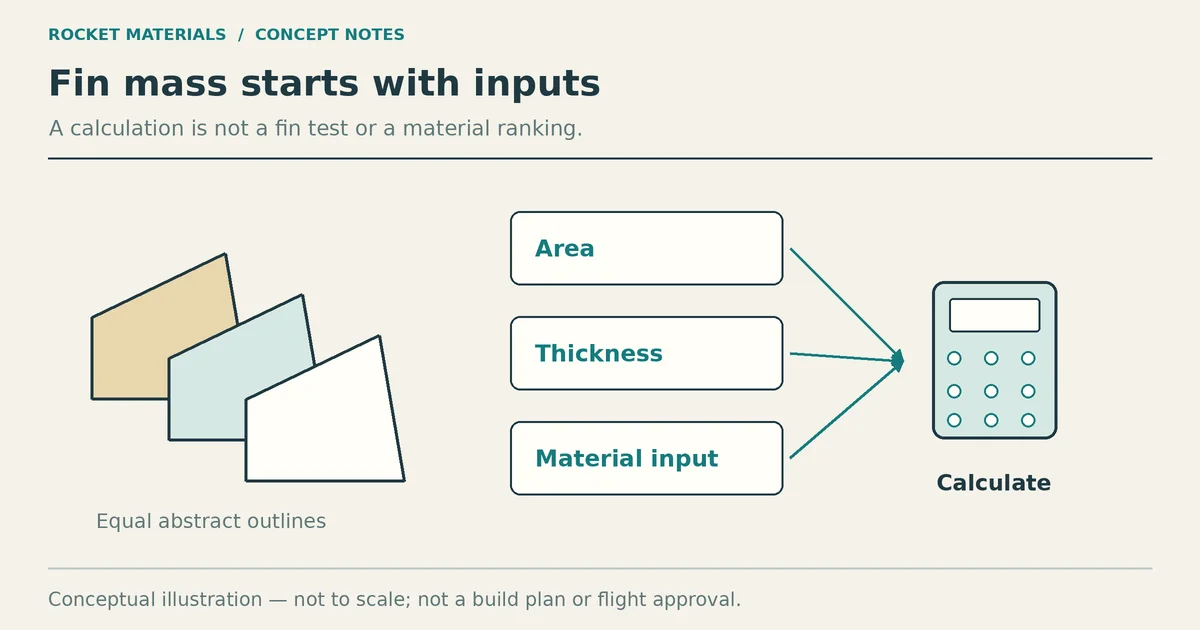
For a uniform hollow tube of length L, mass is approximately density × π/4 × (OD² − ID²) × L, using consistent units. Mass per length therefore depends on both material density and the material cross-section. This geometric relationship explains why an unusually thin paper tube may beat a thicker paper tube, and why comparing a small-diameter tube against a larger fiberglass tube would be misleading. The approximation assumes a reasonably uniform wall and doesn’t account for coatings, grooves or local reinforcement.
Blue Tube 2.0 illustrates another labeling trap. The 38 mm tube above is an Always Ready Rocketry product sold by Apogee, not Apogee’s paper/fiberglass laminate. ARR explicitly says Blue Tube is not phenolic; its site links a vulcanized-fibre material safety sheet. Apogee identifies this SKU as high-density, high-strength paper and lists ARR as manufacturer.[5][6] ARR recommends keeping it dry and finishing with an oil-based sanding sealer. Don’t treat its color as proof of a fiberglass skin or assume it needs no sealing.[6]
We have not inserted a fiberglass or phenolic mass in the table without a comparably documented product, dimensions and length. ARR’s broad percentage comparisons against phenolic and fiberglass are not a substitute for matched-SKU tube weights: tube diameter and wall can change the ranking.[6]
Estimate your own tube mass without promising an altitude gain
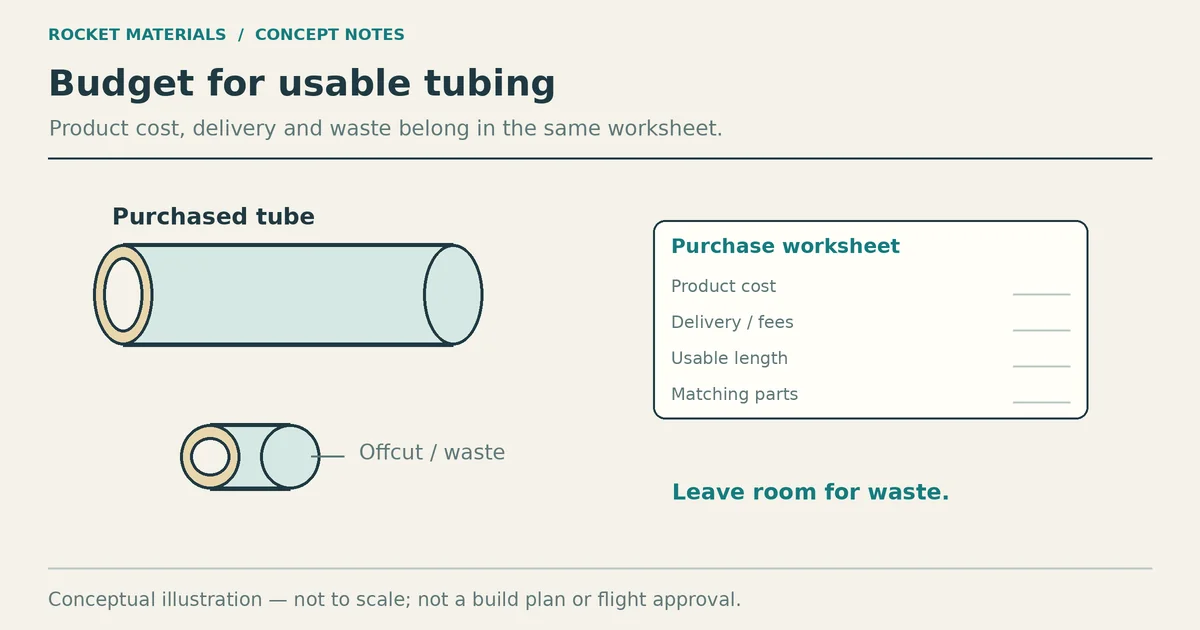
Start with the tube you can actually buy. If its listing says 18 g for 18 inches, the catalog-derived rate is 12 g/ft. A hypothetical 12-inch section of the same uniform tube would be about 12 g before cutting waste, finishing and hardware; an 18-inch section is the listed 18 g.[2] Don’t extrapolate that figure to a different diameter, heavy-wall version or manufacturer.
For your actual build:
- Record supplier, product number, catalog mass, length, OD and ID. Check whether the listed weight belongs to one tube or an entire package.
- Divide mass by length, then multiply by your intended tube length. If you have a sample, weigh the dry, cut piece instead; catalog data are only a planning input.
- Add the mass of rings, mount, couplers, adhesive, finish, recovery system, nose cone and fins to the finished rocket model. A lighter bare tube is not automatically a lighter complete airframe.
- Recheck motor fit, recovery volume, the load path through mount and fin joints, and stability with the chosen motor installed. A thinner wall may need a different joint or protection; that design work can erase the mass saving.
There is no defensible “30 grams saves 500 feet on a C motor” rule. Altitude depends on the complete vehicle, the particular motor thrust curve, drag, launch conditions and recovery configuration. Compare both finished configurations in a flight simulation with their actual masses and geometry before making an altitude claim.
Does a lighter tube change stability?
Yes, potentially. The center of pressure (CP) depends on the rocket’s aerodynamic geometry; replacing a tube without changing its outside shape may leave the modeled CP close to where it was. But mass changes the center of gravity (CG). Remove mass from one section of the rocket and the CG can move toward the remaining mass; the direction and size of the move depend on where that section was and what else is installed. The CG–CP separation, usually expressed in body diameters, can therefore change. Recalculate with the selected motor and recovery payload, and verify the finished rocket, rather than assuming “lighter” means “more stable.”
For model rockets, NAR’s safety code calls for lightweight nonmetal body parts, certified motors, stability checks for an uncertain/untested design and safe recovery. Its high-power code calls for preflight stability checks and certification within the user’s level. Neither code approves a material merely because a motor letter falls in a table.[8][9] If you’re changing an existing kit, follow the kit and motor instructions and get a qualified range safety review where applicable.
Quick answers
Is paper always lighter than fiberglass or Blue Tube?
No blanket ranking is useful without matched dimensions and product masses. The thin paper products in this table are lighter per foot than the listed 38 mm Blue Tube, but they have different walls and IDs. No fiberglass SKU was included, so this table cannot rank fiberglass against them.[1][2][5]
Is LOC’s 38 mm tube phenolic?
Not the listed model 11005: Apogee calls it brown kraft paper, and LOC describes its corresponding 1.52-inch airframe/motor tube under cardboard airframes.[4][7] Verify the exact model before buying, especially if a reseller uses a generic “phenolic” label.
Should I buy the lightest row for an altitude build?
Only if its actual dimensions, joints and recovery space work for the design. The FAI tube is deliberately thin and intended for a specific competition format.[1] Check a complete mass and stability model; don’t infer a safe motor or altitude from its 10.4 g/ft catalog rate.
Next step: Pick a tube by its OD, ID and documented weight, then use the body tube size chart to plan nominal fits. Confirm the actual parts and the complete rocket design. There are no affiliate purchase links in this article.
Sources
[1] https://www.apogeerockets.com/Building_Supplies/Body_Tubes/Low_Power_Thin_Wall_Tubes/40mm_x_9-9in_Body_Tube
> “This tube is designed especially for the 40mm FAI competitions.”
[2] https://www.apogeerockets.com/Building_Supplies/Body_Tubes/Low_Power_Tubes/41mm_x_18_Body_Tube_Estes_BT-60_Size
> “Weight: 18 g (0.63 oz)”
[3] https://www.apogeerockets.com/Building-Supplies/Body-Tubes/Clear-Airframe-Tubes/Clear-Airframe-Tube-41-6mm-18in-1-pk
> “Weight: 41.3 g (1.45 oz)”
[4] https://www.apogeerockets.com/Building_Supplies/Body_Tubes/High_Power_Tubes/38mm_LOC_Body_Tube
> “Material: Brown Kraft Paper”
[5] https://www.apogeerockets.com/Building_Supplies/Body_Tubes/Blue_Tubes/38mm_Blue_Tube
> “Manufactured by: Always Ready Rocketry”
[6] https://alwaysreadyrocketry.com/blue-tube-2-0/
> “For best results, keep dry, rough up the surface with fine sandpaper and seal with a few coats of OIL BASED sanding sealer.”
[7] https://locprecision.com/products/cardboard-airframes
> “Our airframe tubing comes in a wide variety of sizes from thin wall to heavy duty cardboard tubing.”
[8] https://www.nar.org/ModelRocketSafetyCode
> “If I am uncertain about the safety or stability of an untested rocket, I will check the stability before flight and will fly it only after warning spectators and clearing them away to a safe distance.”
[9] https://www.nar.org/HPRSafetyCode
> “I will check the stability of my rocket before flight and will not fly it if it cannot be determined to be stable.”
[10] https://rocketmaterials.org/model-rocket-body-tube-size-chart-complete-compatibility-guide/
> “Check the supplier’s listing for the exact tube you buy. Heavy-wall tubes and similarly named products have different dimensions.”