
Model rocket fin material weight: a calculated comparison
A fin material weight comparison is useful only when the fins have the same shape and thickness. A heavier sheet may make sense for a particular design, but density alone cannot tell you whether it will survive a flight. This guide gives you a reproducible mass estimate for three solid sheet materials, then explains what the estimate leaves out. It is a calculation from published reference densities, not a set of fins weighed at our shop.
Fin weight comparison at equal thickness
The Wood Database lists average dried weights of 9 lb/ft³ for balsa and 26 lb/ft³ for American basswood. Its wood weights refer to a standardized moisture condition, not the density of the sheet in your hand.[1][2] Atlas Fibre lists 1.8 specific gravity for its G-10 glass-epoxy laminate, used here as approximately 1.8 g/cm³; it expressly does not warrant that information for a particular application.[3]
| Solid sheet material | Input density | 1/16 in: g/in² | 3/32 in: g/in² | 1/8 in: g/in² |
|---|---|---|---|---|
| Balsa, species reference average [1] | 9 lb/ft³ | 0.148 | 0.221 | 0.295 |
| American basswood, species reference average [2] | 26 lb/ft³ | 0.427 | 0.640 | 0.853 |
| G-10, Atlas Fibre reference [3] | 1.8 g/cm³ | 1.844 | 2.765 | 3.687 |
These are calculated bare-sheet masses, not measured fin masses, ranges for all commercial stock, or flight-tested material recommendations. The thicknesses are hypothetical equal-thickness comparisons; a particular design may require a different thickness for stiffness, attachment or flutter resistance. Wood density varies with moisture and specimen; balsa varies substantially even within the species.[1][7] G-10 formulations and individual sheets also need product-specific checking.[3]
Reproduce the calculation
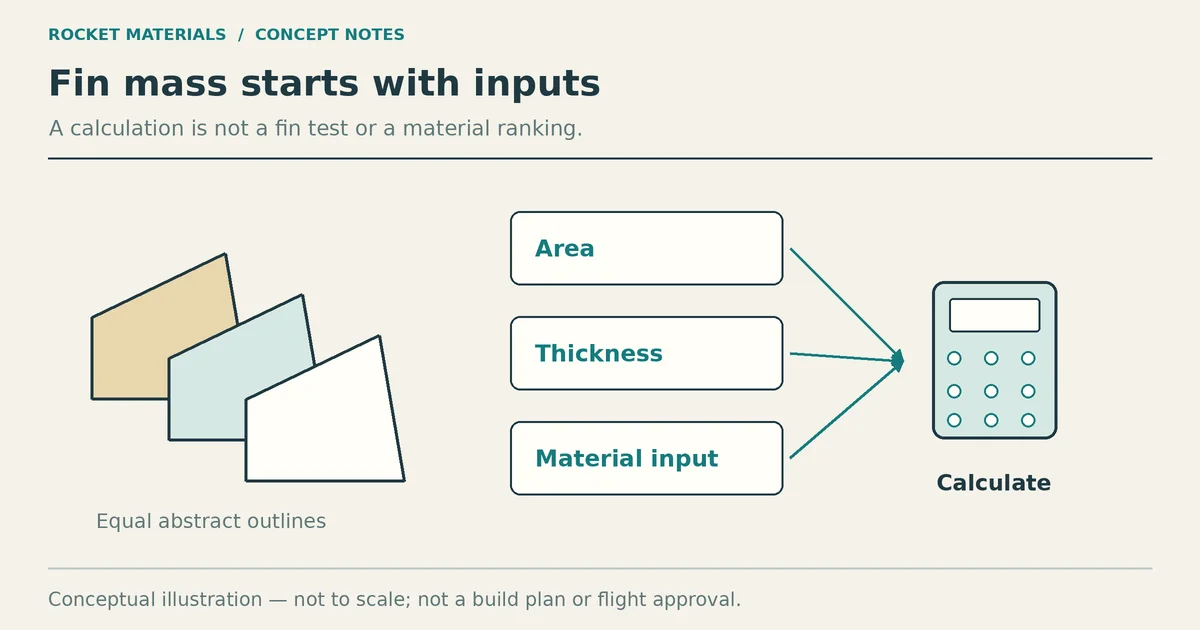
For a uniform solid fin, mass (g) = projected one-face area (in²) × thickness (in) × density (g/in³). The wood conversion is density (lb/ft³) × 453.59237 g/lb ÷ 1728 in³/ft³; for G-10 it is density (g/cm³) × 16.387064 cm³/in³. Divide the result by fin area to get g/in². The table rounds only the final areal result to three decimals.
For example, the balsa reference at 1/8 in is 9 × 453.59237 ÷ 1728 × 0.125 = 0.29531 g/in², or 0.295 g/in² rounded. For G-10 at the same thickness, 1.8 × 16.387064 × 0.125 = 3.68709 g/in². These constants are unit conversions, not empirical fin test results.
Consider a hypothetical set of three uniform, flat fins, each with 4 in² of one-face planform area, cut at 1/8 in thickness. Total planform area is 3 × 4 = 12 in². Before sanding, finish, root tabs or adhesive, the computed set is 3.54 g balsa, 10.24 g basswood, or 44.25 g G-10 using the input densities above. The sheet area actually purchased can be larger because offcuts do not become fins. Do not multiply by two for the fin’s two faces: volume is planform area times thickness once.
What the fin mass estimate does not include
Papered balsa is a laminate. You must add the balsa core, paper on both faces, adhesive and finishing mass separately; the original draft’s single “papered balsa density” could not describe every paper and glue combination. Plywood includes plies and glue, so a species’ solid-wood density is not a substitute for the actual plywood panel’s mass per area. Carbon-fiber laminate depends on fabric, resin and layup. A printed PETG or PLA fin depends on shell count, layer height, infill pattern and geometry. In particular, a nominal 1.6-mm-thick print with 1.6-mm solid walls cannot also be assumed to contain a substantial 40% infill region. We have no verified SKU- or process-specific areal masses for those options; weigh a representative cut or print rather than borrowing the solid-sheet table.
Use a scale and calipers if the design matters: weigh the actual sheet or finished fin set, note thickness and one-face area, and record whether the result includes glue, paper, paint and root tabs. Compare options at equivalent geometry and at thicknesses that independently meet the design loads. The calculated table is a planning tool, not a substitute for a structural check.
Weight, stability and altitude are different questions
Replacing an aft fin set with a heavier one generally moves the rocket’s center of gravity (CG) rearward if the rest of the vehicle stays the same. With fin shape and placement unchanged, the aerodynamic center of pressure (CP) does not move rearward simply because the fins weigh more. A rearward CG can reduce, not increase, the CG-to-CP static stability margin. NASA describes a stable model rocket with CP aft of CG, and Apogee explains how added aft weight affects the balance point.[5][6]
Measure or model the complete flight-ready rocket with its intended motor and recovery system after changing fins. Check CP, loaded CG, attachment, fin stiffness and recovery for that configuration; do not infer a safe motor class from material or thickness. NAR’s Model Rocket Safety Code calls for lightweight, non-metal nose, body and fins, certified commercially made motors, and a stability check when the safety or stability of an untested rocket is uncertain.[4] That is why the original aluminum-fin suggestion has been removed rather than presented as another model-rocket material choice.
Mass changes can affect altitude, but this table cannot predict a number of feet gained. The result also depends on total lift-off mass, motor thrust curve, drag, fin profile, launch conditions and stability. We have no flight record or reproducible simulation for the original draft’s altitude claims. There is likewise no universal “nose weight equal to added fin weight” rule: locations and the entire mass distribution determine the shift. A heavier rocket may also need a recovery-system reassessment rather than a chute change chosen from fin mass alone.
A short checklist before you cut
Sketch the fin outline and find its one-face area; subtract cutouts, but include any root tab you intend to weigh. Confirm actual sheet thickness rather than relying on a nominal label. Use the table to compare bare sheet only, then weigh a finished representative fin if you add paper, epoxy, paint or a shaped airfoil. If you are swapping materials on an existing rocket, weigh the complete replacement set and recheck the loaded balance point. Keep the result with the rocket’s build notes so the next replacement uses the same assumptions. This is more useful than a generic material ranking because it ties the number to the part you will actually fly.
Choosing a material without guessing at performance
If minimum calculated sheet mass matters, compare the actual balsa stock and finish at the thickness your design needs. Basswood’s reference density yields a heavier same-geometry fin than balsa, but the two are not interchangeable just because they are wood.[1][2] G-10 has a substantially larger same-thickness calculated mass here; choosing it for stiffness or construction reasons requires a separate vehicle-specific design assessment.[3] Cut and sand composite sheets with appropriate dust controls, then inspect the finished edges and attachments.
For layout and attachment, follow the kit instructions and measure your actual fin stock. This mass calculation does not validate the complete flight design or a printed substitute.
Disclosure: This article has no affiliate purchase links. No product or price recommendation is implied by the example densities.
Sources
[1] https://www.wood-database.com/balsa/
[2] https://www.wood-database.com/basswood/
[3] https://www.atlasfibre.com/material/g-10/
[4] https://www.nar.org/ModelRocketSafetyCode
[5] https://www1.grc.nasa.gov/beginners-guide-to-aeronautics/rocket-stability/
[6] https://www.apogeerockets.com/Peak-of-Flight/Newsletter594
[7] https://extension.psu.edu/calculating-the-green-weight-of-wood-species





One Comment