Body tube strength by diameter: what size cannot tell you
If you searched for body tube strength by diameter, you may be hoping for a chart that says which BT size will survive your motor. There is no defensible chart like that in this article. We do not have comparable crush tests for identified tubes, and a tube’s nominal diameter is not a motor rating. The useful question is whether the specific airframe and its joints work with the selected motor and recovery system. This guide explains what size can tell you, what it cannot, and what information to collect before choosing or changing a tube.
Why a wider tube is not automatically a stronger rocket
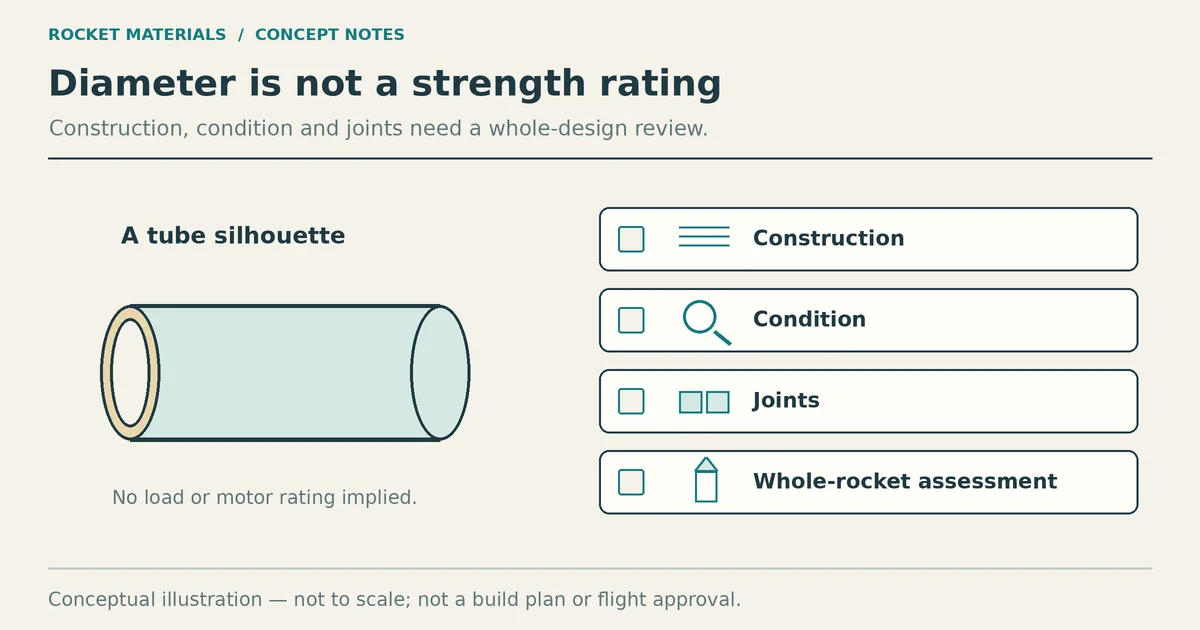
A tube’s load capacity depends on more than its outside diameter. Its wall, length, material construction, defects, moisture exposure, joints and support all matter. A larger outside diameter can come with a thinner wall or a different construction. Nor is the body tube necessarily carrying the motor’s peak thrust as a uniform end-on compressive load: the motor mount, retention, centering rings and their bonds determine where loads enter the airframe.
The distinction matters when you see a claim such as “BT-60 handles E, BT-80 handles H.” Motor letters describe impulse classes, not a certification of any tube or completed rocket. The NAR safety codes require certified motors used as their manufacturers recommend, and address stability and recovery; the high-power code also requires appropriate user certification. They do not provide a BT-size-to-motor approval table.[4][5] NAR’s high-power certification levels describe which motor classes a person may purchase and use, not what an airframe can withstand.[6]
What the BT label can tell you
BT labels are useful starting points for finding mating parts. For standard thin-wall paper stock, eRockets lists BT-20 at 0.736 in outside and 0.710 in inside diameter; BT-60 at 1.640 in outside and 1.600 in inside diameter; and BT-80 at 2.600 in outside and 2.558 in inside diameter.[1] These are supplier-listed dimensions, not strength measurements or specifications for a fiberglass or phenolic product with a similar name. A paper BT-80 does exist in that catalog.[1]
Our published body tube size chart has the full thin-wall paper BT reference and fitting advice. Use it for dimensions, then check the exact maker’s listing and the physical parts you receive. This page deliberately does not repeat the chart or turn its dimensions into motor recommendations.[2]
A motor’s diameter is a separate question from the airframe’s diameter. The motor fits its mount; centering rings connect that mount to the airframe. Check the actual motor, mount tube, ring and airframe dimensions rather than treating an airframe’s BT label as the motor-mount size. The size chart’s fitting walkthrough explains which inside and outside surfaces must mate.[2]
Why the old crush and buckling numbers had to go
The earlier version of this draft attributed a table of approximate crush loads to measurements on 12-inch samples while mixing claimed published data with engineering estimates. It identified no specimen SKU, sample log, test fixture, protocol or raw readings. Those numbers cannot be treated as measured loads, comparative material rankings or safe flight margins. We have removed the table rather than dressing estimates up as observations.
It also gave a 24-inch Euler buckling table with unverified moduli, section properties and end constraints; the stated outputs did not follow from its own inputs. Euler’s ideal-column equation is not a shortcut to a flight-ready motor rating. Without real tube geometry and properties, an identified unsupported length, connection conditions and an engineering review of other failure modes, a calculated column load would create false precision. No revised buckling table is offered here.
There are several ways an assembly may fail or become unsafe: a damaged tube, a failed mount bond, a weak joint, a loose component or a compromised recovery system. A single compression number would not establish the performance of those other parts. Do not substitute a “three times peak thrust” rule or a material name for a review of the finished design.
A practical selection checklist
- Start with the actual rocket: kit instructions or a documented design, intended flight configuration, and the specific motor manufacturer’s instructions. Do not enlarge the motor choice because a replacement tube has a larger nominal diameter. The NAR model and high-power codes call for certified motors used as recommended.[4][5]
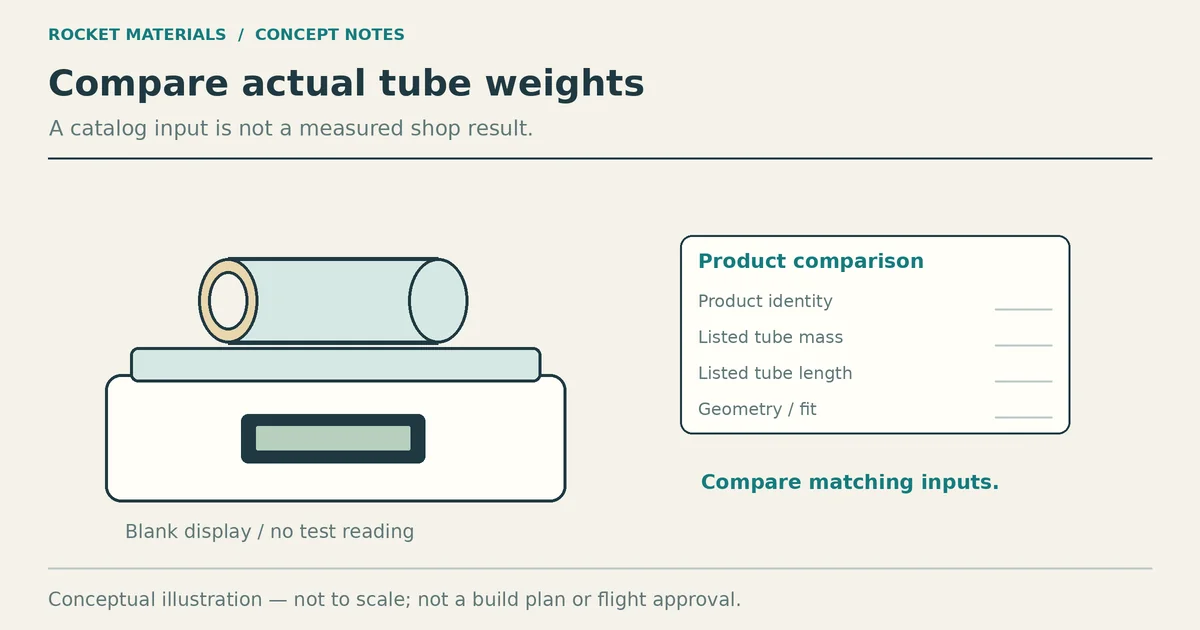
- Record the supplier and product identifier for the airframe and mount. Get the listed outside diameter, inside diameter, wall and length for that product. Dry-fit the nose cone, coupler and centering rings before bonding; the paper reference chart does not certify the fit of unlike products.[1][2]
- Inspect the airframe and its load path, especially mount attachment, couplers, fin attachment and any dented or wet sections. A change of material or diameter changes weight and geometry; reassess stability, launch guidance and recovery for the finished rocket rather than assuming the old configuration still works. NAR’s codes explicitly address stability or uncertain stability and safe recovery.[4][5]
- For an unfamiliar, modified or high-power design, document the selected motor, assembled mass and configuration, and obtain design-specific review from a qualified club mentor or range safety personnel before flight. High-power certification is a requirement on the flyer, not a structural sign-off on the rocket.[5][6]
If you cannot establish the tube’s identity, mating dimensions or condition, do not infer a safe motor from a diameter chart. Seek a documented kit or supplier specification and a review of the actual build.
Does material choice settle the strength question?
No. “Fiberglass,” “phenolic” and “paper” cover products with different constructions and dimensions. A material category alone does not give a comparable axial failure load, impact resistance or safe motor class. Request product-level evidence instead of relying on broad material-to-motor charts.
Blue Tube 2.0 is another distinct product, not a generic PVC tube or a phenolic grade. Always Ready Rocketry describes it as its proprietary spiral-wound airframe product, says explicitly that it is not phenolic, and advises keeping it dry and sealing it with oil-based sanding sealer.[3] The manufacturer’s report of a crush test on three specific samples is not a BT-20-through-BT-80 comparison or a universal rating for another tube or assembled rocket.[3]
The useful next step is modest: use the published paper size chart to identify likely mating dimensions, then confirm the chosen product and complete flight configuration. If you need a strength limit, ask the supplier for applicable product-specific test data and consult someone qualified to evaluate the whole design. No tube here is endorsed for a motor class on diameter alone.
Sources
[1] https://www.erockets.biz/body-tube-sizes/
[2] https://rocketmaterials.org/model-rocket-body-tube-size-chart-complete-compatibility-guide/
[3] https://alwaysreadyrocketry.com/blue-tube-2-0/
[4] https://www.nar.org/ModelRocketSafetyCode
[5] https://www.nar.org/HPRSafetyCode
[6] https://www.nar.org/HPRCertification