
Basswood vs Plywood Rocket Fins: Weight, Grain and Fit
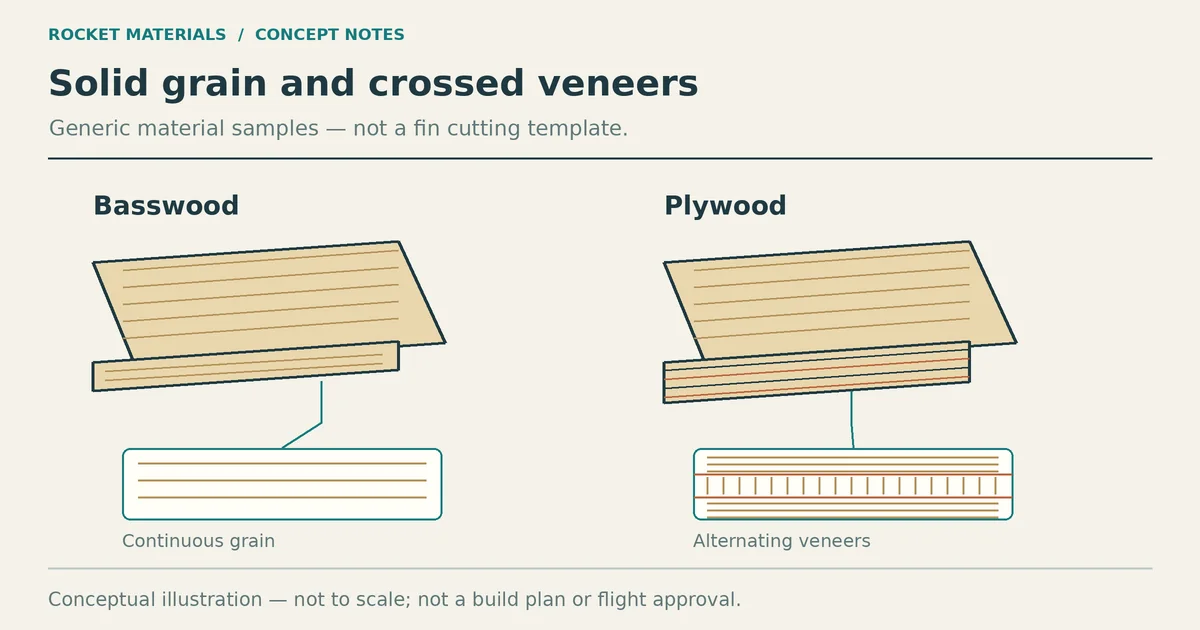
Basswood vs plywood rocket fins is mostly a question about grain, weight and the shape of your fin, not the letter on the motor. Basswood is solid wood: pleasant to cut and sand, but its properties change with grain direction. Plywood has veneers running in alternating directions, which makes it more forgiving when a fin’s outline puts loads across the face grain. Neither choice makes an untested rocket safe on its own.[2][4]
The short answer
| Decision point | Solid basswood | Plywood |
|---|---|---|
| Grain | One predominant direction; orient each blank deliberately | Cross-laminated veneers carry loads in both panel directions, though strengths still differ by direction and layup[2] |
| Cutting | Thin stock can be shaped with sharp hand tools | Thicker stock usually calls for a saw; avoid tearing face veneers |
| Finish | One continuous edge to sand and prime | Exposed layers and possible voids need inspection and edge filling |
| Mass | Depends on actual sheet density and fin area | Depends on veneer species, core, adhesive, layup and thickness; do not assume a generic “birch” density[5] |
| Better starting point | A hand-cut design with a simple grain path and modest span | A curved or broad fin, or a design where cross-grain behavior and a repeatable sheet matter |
Those are shopping and fabrication considerations, not flight ratings. A fin can also fail at its root joint even when the wood remains intact. Check the whole fin design and attachment, not just the sheet label.
Why the grain matters
Basswood is a hardwood botanically, but the Wood Database describes it as soft and easy to work; “hardwood” does not mean every piece is hard to cut.[6] A solid basswood blank has one grain direction. Lay the template on the actual sheet and think about how a load at the tip reaches the root. Avoid a thin corner whose fibers run out of the edge. There is no universal root-to-tip grain rule for every planform; the direction that helps one narrow fin can leave another’s long edge vulnerable. Follow the kit’s grain marks where supplied.
Plywood bonds veneers with their grain directions crossed. APA’s plywood overview describes improved dimensional stability and strength in both panel directions, while noting that stiffness and strength vary with the panel and the direction of load.[2] That is a practical reason to consider it for a wide sweep or curved outline. It does not mean plywood is equally strong in every direction, immune to cracking, or automatically suitable for a high-speed rocket. Check the edges for voids or loose layers and reject a flawed blank where the root or narrow tip would fall.
What would four fins weigh?
The original draft quoted 0.9 oz basswood versus 1.6 oz plywood for a BT-50 fin set without defining the fin outline. A body-tube designation does not tell us the area of a fin. Here is a reproducible material-only illustration instead, not a measured fin set or a recommended fin size:
- Four solid rectangular blanks, each 3 in × 2 in × 3/32 in: total area 24 in² and volume 2.25 in³.
- Wood Database basswood data list an average dried weight of 26 lb/ft³; the modeled set is about 15.36 g (0.54 oz).[6]
- Aircraft Spruce’s domestic birch plywood listing gives 3/32 in, 3-ply, and an approximate 12 lb per 4 × 8 ft sheet. At nominal thickness that implies 48 lb/ft³; the modeled set is about 28.35 g (1.00 oz).[5]
Formula: mass (lb) = [number of fins × face area (in²) × thickness (in) / 1,728] × density (lb/ft³). This assumes an uncut rectangle, uniform nominal thickness and the seller’s approximate sheet mass. A tapered or swept outline removes area; paint, glue and fillets add mass. The Wood Database average describes a species, not a particular hobby sheet, and the Aircraft Spruce product has birch faces with poplar or basswood cores, not three all-birch veneers.[5][6] Weigh your actual stock or cut fins for the flight model. The implied difference in this illustration is about 13.0 g, not a promised altitude gain.
Cutting and finishing
For basswood, trace the outline on the sheet, mark the grain, cut conservatively and sand to the line. Support thin edges so they do not split while shaping. For plywood, verify the ply count and nominal thickness on the product listing; a name like “aircraft birch” covers different constructions. Aircraft Spruce, for example, lists 3-ply at both 3/32 in and 1/8 in in its domestic line, while its Finnish birch line lists 5-ply at nominal 3/32 in (2.5 mm).[5][9] Avoid promising a ply count from thickness alone.
After cutting, inspect the root and tip for voids and separated veneers. Fill exposed plywood edges before priming if you want the layers to disappear under paint. Keep dust out of your breathing zone and follow the tool and adhesive manufacturers’ instructions. A hand saw, scroll saw or suitable cutter may be easier than forcing a knife through plywood. Laser cutting depends on the particular wood, glue, machine and ventilation; there is no transferable wattage setting here.
Make a dry fit on the actual tube and use the kit’s alignment marks or a suitable jig while the joints cure. If the design needs a stronger attachment, evaluate the actual joint and follow the kit or component instructions rather than simply switching woods.
Choose the stock for the rocket, not the motor letter
Start with the supplied kit plan if building a kit. On a scratch build, choose the outline, span, thickness, grain orientation, fin attachment, expected flight loads, recovery conditions and total mass together. Compare actual sheet stock and reject damaged material. The NAR Model Rocket Safety Code calls for lightweight, non-metal parts and checking the safety or stability of an untested rocket. The High Power Rocket Safety Code requires a stability check before flight and sets certification and launch requirements.[3][4] Neither code gives a blanket basswood/plywood thickness or motor-class approval.
This also rules out the old draft’s claims that basswood “handles E and F,” plywood is good for “G through O,” or that a particular thickness is standard for an E motor. They were not supported by a tested fin design. For a demanding or high-power design, verify the fin and joint against its planned flight conditions and have the range safety team review it. Do not use this comparison as structural approval.
Questions builders ask
Is plywood always heavier than basswood?
Not necessarily across arbitrary sheets or thicknesses. In the same rectangular geometry above, the specific basswood reference and domestic plywood listing produce different modeled masses. A thinner or differently cored plywood sheet could change the comparison. Measure the stock you intend to use.[5][6]
Can basswood be laser cut?
It may be cut on equipment approved for that stock, but settings and edge quality depend on the machine and sheet. Check material and adhesive compatibility with the cutter’s manufacturer and provide appropriate ventilation. Do not borrow settings from a different machine.
Do I need to seal plywood edges?
If you want a smooth painted edge, fill and prime the exposed plies. Inspect for voids first; filler does not fix a bad structural blank. Check the finish and the wood after wet handling; this article does not establish a moisture-proof coating system.
Can I mix the materials?
You can make a built-up fin, but the joint, mass and stiffness then depend on the whole assembly. There is no tested universal basswood-plus-plywood recipe in this article. Build and verify a design-specific joint instead of adding a strip based on a generic claim.
Bottom line
Basswood is convenient when you can orient the grain well and shape the fin by hand. Plywood’s crossed veneers make it worth considering for outlines where a single grain direction is awkward. Compare actual sheet construction and measured mass; then check the attachment and the rocket as a system.
Sources
[2] https://www.apawood.org/engineered-wood-products/plywood-osb/plywood
[3] https://www.nar.org/ModelRocketSafetyCode
[4] https://www.nar.org/HPRSafetyCode
[5] https://www.aircraftspruce.com/catalog/wppages/domplywood2.php
[6] https://www.wood-database.com/basswood/
[9] https://www.aircraftspruce.com/catalog/wppages/finnishbirch.php