Model Rocket Body Tube Cost Per Foot: A Budgeting Method
A cheap-looking body tube can become the expensive one after shipping, cut waste and a new set of couplers. If you’re comparing model rocket body tube cost per foot, start with the actual products you can buy, not a single price range for cardboard, phenolic, fiberglass or Blue Tube. Diameter and wall thickness change what you get for the money. A nominal BT label does not promise the same fit across materials.[4]
This is a worksheet for a purchase you are about to make. It contains no current retail price table: without dated supplier SKUs of comparable size, that table would give you false precision. Gather two or more listings, fill in the blanks below and check the complete rocket design before choosing a tube.
What to record before calculating cost per foot
Copy these fields from each listing or ask the supplier when one is missing:
| Field | Why it matters |
|---|---|
| Supplier, product URL/SKU and date checked | Lets you revisit the same offer when the price changes |
| Product line and material | A paper BT tube and a fiberglass tube are not interchangeable on name alone |
| Outside diameter (OD), inside diameter (ID) and wall | Determines fit with couplers, nose cones and centering rings |
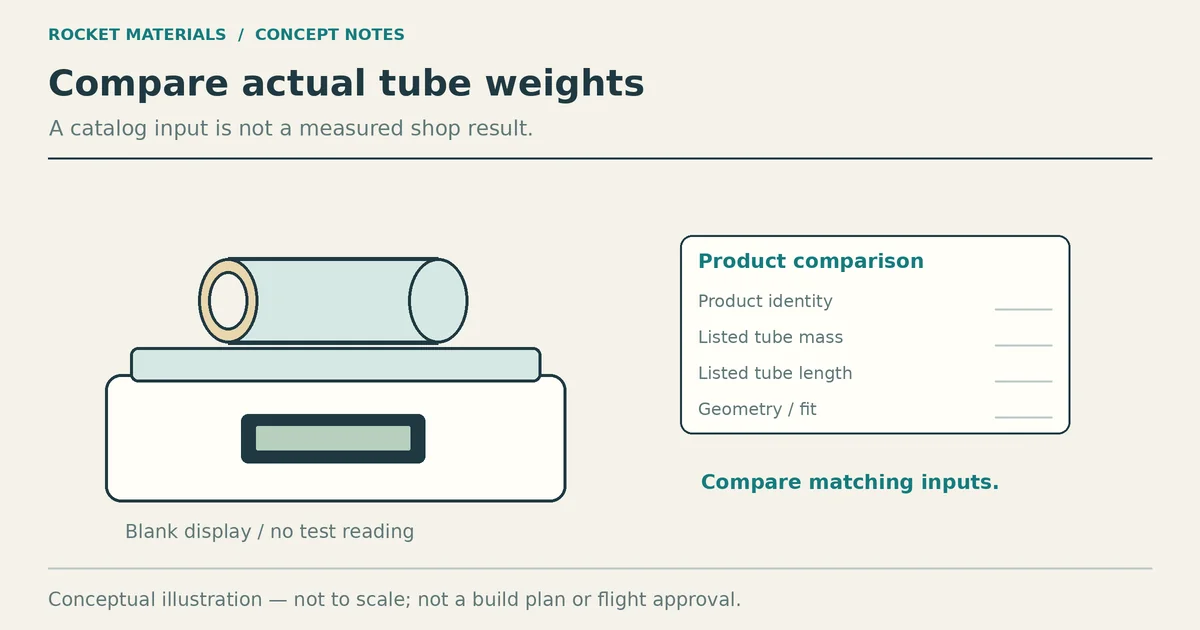
| Sold length and price per piece or pack | The denominator and numerator of the calculation |
| Quantity, cut fee, shipping and tax to your address | Turns shelf price into delivered cost |
| Planned cut lengths and usable offcuts | Distinguishes purchased footage from tube you can use |
| Matching components and any finishing supplies | Captures costs caused by changing tube families |
The site’s corrected body tube size chart lists dimensions for standard thin-wall paper tubes and warns that heavy-wall or similarly named products may differ. Use that chart to understand the names, then use the dimensions of the specific product you intend to order. For a nose cone or coupler that goes inside the tube, compare its OD to the tube’s ID; dry-fit before gluing.[4]
Calculate the listed price per foot
For a single tube sold in inches:
listed price per foot = listed tube price × 12 ÷ sold length in inches
For a pack, divide the pack price by the combined sold length. Keep currency, pack quantity and units in your notes. If a seller lists millimeters, convert consistently rather than treating a nominal 38 mm tube as an exact counterpart to a paper BT tube.[4]
Here is a hypothetical arithmetic example, not a supplier quotation: a 24-inch tube priced at $12 has a listed price of $6 per foot. That figure does not include freight, tax or waste. Replace both inputs with the dated listing you actually found.
Calculate delivered cost per usable foot
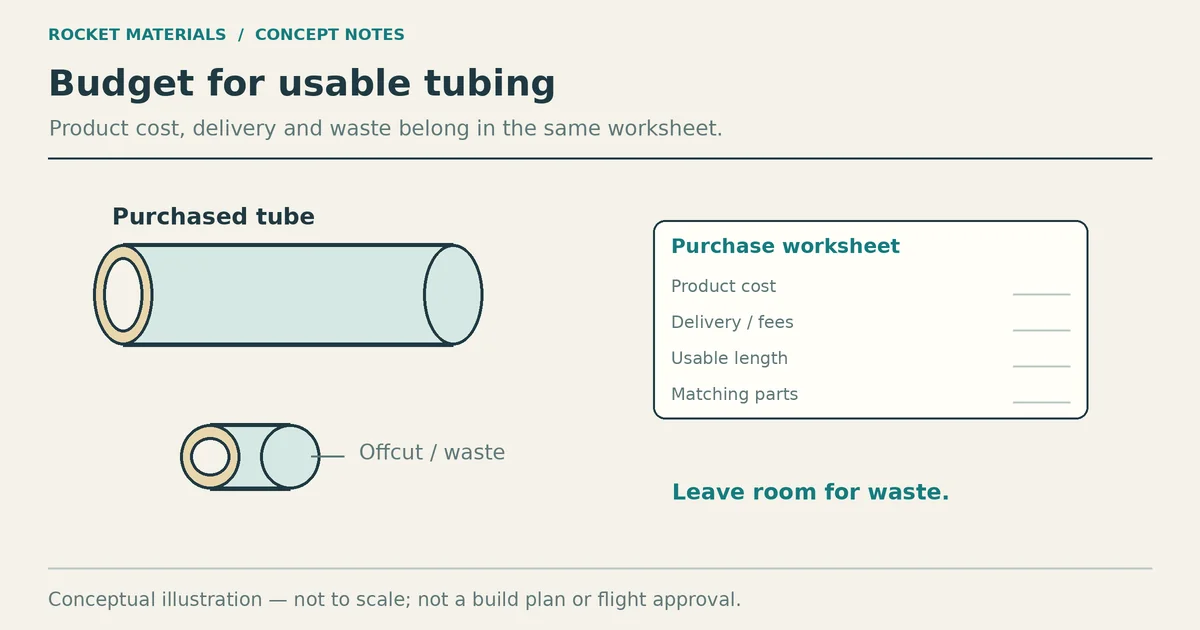
The tube you pay for and the tube you can cut into your rocket are not always the same length. First sketch a cut plan. If a cut or damaged end makes part of the order unusable, count only the usable length; count an offcut if you genuinely have a planned use for it.
delivered cost per usable foot = (tube or pack price + allocated shipping + cut fees + tax) × 12 ÷ usable inches
Using the same made-up teaching inputs, suppose you buy two 24-inch tubes at $12 each, pay $8 shipping and can use 18 inches from each tube. The calculation is (2 × 12 + 8) × 12 ÷ 36 = $10.67 per usable foot after rounding. This is not a market estimate. A different cut plan, cart or destination changes the result.
Shipping allocation needs one explicit rule. If you’re ordering other parts in the same cart, either charge the entire shipping bill to the tube (conservative for a tube-only decision) or allocate it consistently among the items. Don’t compare one seller’s pre-shipping price to another seller’s landed price. For a project total, write down the actual tube quantity you must buy, not just the theoretical length consumed.
Compare like with like, then price the whole assembly
A fair material comparison starts with the same required airframe diameter, a compatible ID for the mating parts, adequate wall and sold lengths that can produce your cut plan.[4] The cheapest cost per foot at a smaller diameter does not tell you which tube is cheaper for the same rocket. Nor does a fiberglass tube with a different wall necessarily accept the paper-tube coupler you already own.[4]
Make a small shortlist rather than a universal material ranking:
- Define your finished rocket’s required OD/ID, airframe sections and fitting parts. Check actual supplier dimensions, not a family name.
- Record the SKU, retrieval date, quantity, sold length and delivered price for each viable tube. If a specification is missing, ask the seller instead of assuming it.
- Lay out the cuts and compute delivered cost per usable foot. A longer tube can reduce waste, but its shipping cost may erase the saving.
- Add the nose cone, couplers, centering rings, adhesives or surface preparation that change with the tube choice. Keep any existing parts you can reuse as a separate line, not as a fictional zero-price listing.
- Evaluate the completed design, mass and flight conditions before ordering. An inexpensive tube is not a bargain if the design does not work safely.
You can use a four-column scratch sheet: product/SKU | dimensions and usable inches | delivered tube total | compatible-parts total. Keep a fifth note for the date and supplier link. That makes a later re-quote quick, without presenting stale prices as current advice.
Material-specific checks
Paper tubes are a reasonable starting option when a kit or evaluated design calls for them. Their standard BT dimensions are documented separately from heavier-wall products.[4] Confirm the stock and finish you will actually use.
Phenolic and fiberglass deserve separate SKU comparisons.[4] Their nominal diameters and matching hardware may differ from standard paper stock; do not transfer the paper chart’s ID to a phenolic or fiberglass cart.[4] Request dimensions and current price for the exact product rather than extrapolating from an undated material comparison.
Blue Tube 2.0 is an Always Ready Rocketry (ARR) product, manufactured for ARR under contract.[1] ARR explicitly says it is not phenolic; it should not be listed as an Always Composite fiberglass SKU.[1] ARR says to keep it dry and apply oil-based sanding sealer for best results, so include finishing materials in your own cart if you choose it.[1] Obtain the exact ARR product’s current dimensions and price before including it in a comparison; the name alone supplies neither.
Cost is not a motor rating
A motor’s impulse class does not certify an airframe material. NAR’s high-power code permits lightweight construction materials including paper and fiberglass, but also requires certified motors, stability checks and a recovery system.[2] It does not say paper is automatically disallowed for an F motor or that fiberglass automatically makes an L, M or O project safe.[2]
For context, NAR describes Level 1 as H/I, Level 2 as J/K/L and Level 3 as M/N/O; some F and G motors also require Level 1 certification.[3] Those are permissions and procedures, not tube recommendations. Check the actual motor and mount, thrust and mass, structural load paths, stability, recovery and launch-site requirements for your vehicle.[2]
For a certification project, review the plan with the relevant certifying and range personnel before buying an airframe on the strength of a cost comparison.[2][3]
Water exposure, a damaged joint or a hard landing calls for inspection, not a promise that any material will ‘fly fine.’ Follow the material supplier’s preparation instructions; ARR explicitly says to keep Blue Tube dry.[1] When cutting or sanding, use the protection specified by the supplier and control dust; ARR specifically recommends eye and dust protection for Blue Tube.[1]
Questions that come up while shopping
Is the lowest listed price per foot the cheapest build?
Not necessarily. Shipping, cuts, wasted length and incompatible hardware can change the project total. Calculate both the listed and delivered usable figures, then price the matching parts.
Can I compare a 38 mm tube with a BT-sized paper tube?
Only after checking their actual OD, ID, wall and part fit. A nominal diameter is not a promise that the tubes can use the same nose cone or coupler.[4]
Should I buy a premium material for a certification flight?
Not on its name alone. Pick a material and construction that work in the specific rocket design, then get the required reviews and comply with the relevant safety code. Certification level does not substitute for a design check.[2][3]
What if a seller doesn’t publish a wall thickness or SKU?
Ask for the dimensions and a product identifier before making a fit or cost comparison. A low number based on an unspecified tube is not a useful quote.
Keep the quote with the build plan
Save the dated product links, cut sketch and shipping assumption alongside your bill of materials. Recalculate before you order. If you still need to settle fit, use the body tube size chart.[4]
For adjacent build decisions, use the instructions and dimensions for the actual kit or parts. A materials budget does not establish flight suitability or fin alignment.
There are no affiliate purchase links in this article. Supplier and related-reading links are informational; no commission is claimed for them.
Sources
[1] https://alwaysreadyrocketry.com/blue-tube-2-0/
> “Blue Tube 2.0 is manufactured exclusively under contract for Always Ready Rocketry, LLC”
> “For best results, keep dry, rough up the surface with fine sandpaper and seal with a few coats of OIL BASED sanding sealer.”
[2] https://www.nar.org/HPRSafetyCode
> “I will use only lightweight materials such as paper, wood, rubber, plastic, fiberglass, or when necessary ductile metal, for the construction of my rocket.”
[3] https://www.nar.org/HPRCertification
> “Level 1 allows the purchase and use of H and I impulse class motors; solid and hybrid. Certain F and G motors may also require Level 1 certification for purchase and use.”
[4] https://rocketmaterials.org/model-rocket-body-tube-size-chart-complete-compatibility-guide/
> “Heavy-wall tubes and similarly named products have different dimensions.”