
Fin Grain Direction: The Complete Guide
Solid-wood fin grain is a structural detail: the fibers do not respond identically to loads in every direction. The practical starting point is the kit’s cutting diagram, not a universal angle measured from the fin root.
Use the leading edge as the reference
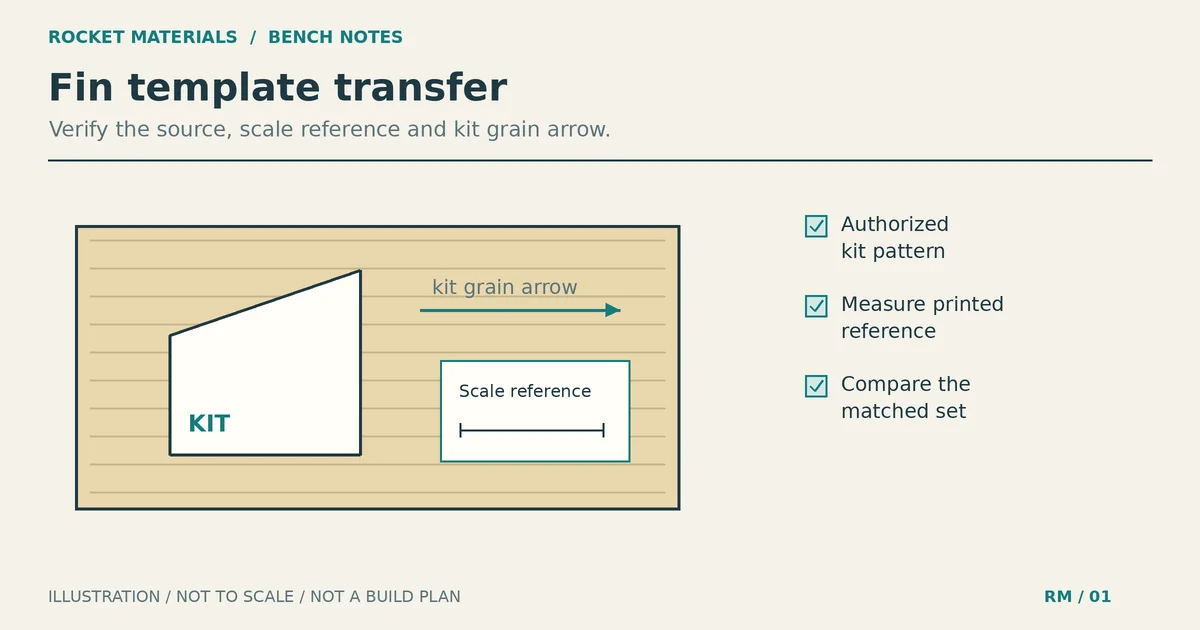
On a typical swept solid-wood fin, a common supplier guideline is to orient grain approximately parallel to the leading edge so the fibers lead back toward the root/body. Apogee’s fin-material demonstration discusses this convention and shows why the actual grain on the sheet matters. The leading edge is the edge facing the rocket’s direction of travel; the root is the edge attached to the body tube. They are not interchangeable references.
- Identify the grain lines on the actual balsa or basswood sheet and mark their direction lightly.
- Lay the kit template on the stock in the orientation shown by its plan. For a swept custom solid-wood fin, examine whether the grain follows the leading edge toward the root; consider how the fin will attach and where it may split.
- Trace the required number of fins consistently, then inspect the cut pieces for weak, split or warped stock. Use the kit’s attachment and finishing instructions.
For supported cuts and shallow knife passes, see how to cut balsa wood for model rocket fins.
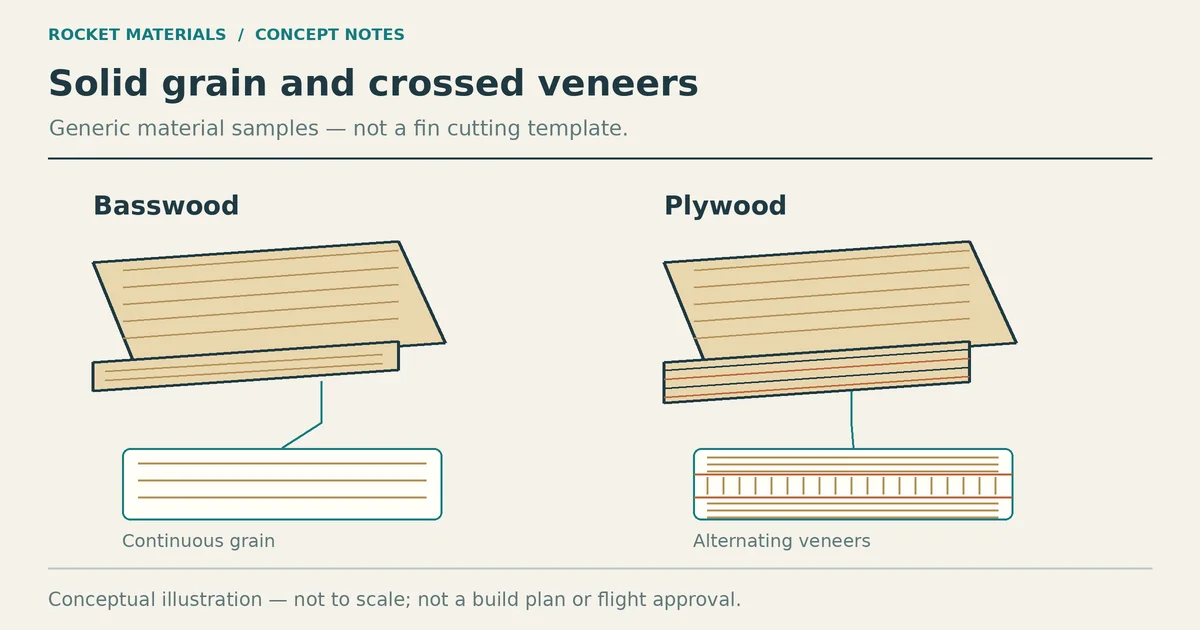
Neither grain perpendicular to the root nor a diagonal measured from the root is a universal optimum. Fin shape, sheet grade, thickness, wood species and attachment all matter. Plywood and other laminated materials need their own layup assessment rather than a single solid-wood rule.
Limits of a grain check
Grain direction alone does not establish a flutter speed or flight stability. Apogee’s fin-flutter analysis includes geometry, thickness, material properties and flight atmospheric conditions in a design-specific estimate. For a modified or uncertain rocket, check structure and stability under the applicable NAR model-rocket safety code or high-power code.
Do not map the wood-grain guideline directly to 3D-printed layer orientation. Printed-part strength depends on interlayer bonding, print settings and the actual load path.