Model rocket tube wall thickness: fit a motor mount
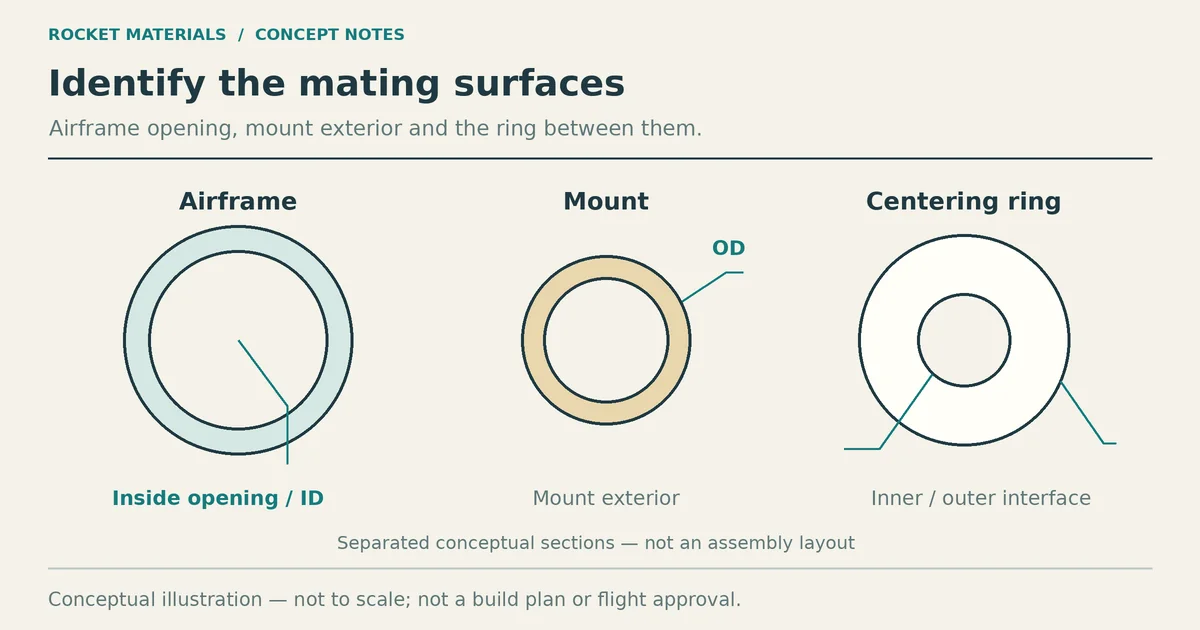
A tube marked “38 mm” is not necessarily interchangeable with every other tube sold under that label. For a motor mount, the useful numbers are the airframe’s inside diameter (ID), the mount tube’s outside diameter (OD), and the dimensions of the centering ring between them. Wall thickness helps explain the difference, but it is not a motor rating.
This model rocket tube wall thickness guide works through actual supplier listings rather than assigning one wall measurement to every BT size. If you need the standard paper BT-5 through BT-80 dimensions, use our body tube size chart. This page is about what to measure when you mix product lines or cut a ring for a particular build.[8]
What wall thickness tells you, and what it doesn’t
For a tube with uniform walls, wall thickness = (OD − ID) ÷ 2. The wall occupies space on both sides of the opening. If you have an OD and a wall specification, ID = OD − 2 × wall. Those equations describe geometry, not manufacturing tolerance or structural strength.
Take Apogee’s model 10141, a kraft-paper, BT-60-size tube: its listing gives 1.637 in OD and 1.595 in ID. The calculated wall is 0.021 in. eRockets’ BT-60/ST-16 row instead prints 1.640 in OD, 1.600 in ID, and 0.021 in wall. The diameter pair gives 0.020 in by subtraction; the slight mismatch in that catalog row is a reminder not to treat rounded listing numbers as a precise measurement of your tube.[2][1]
The BT labels describe familiar size families, not a promise that another supplier’s phenolic, fiberglass, or Blue Tube product has the same ID, OD, or shoulder fit. LOC calls its 1.52-in airframe a 38-mm tube and says it has a 1.525-in ID and 0.050-in wall, implying a 1.625-in OD. Apogee lists the corresponding LOC-manufactured model 11005 with the same 1.525-in ID but a 1.635-in OD (0.055-in wall by subtraction).[3][9] Those catalog figures conflict; neither is a measured tolerance or a reliable centering-ring OD for your delivered part. Measure the actual tube and check the matching ring before cutting or bonding.
Supplier-specific dimensions for a real fit calculation
These are listed products, not a universal BT wall chart. The wall and implied OD marked “calculated” come from the listed diameters; they are not shop measurements.
| Product and maker | Listed ID | Listed OD | Wall from listed figures | Why it matters |
|---|---|---|---|---|
| Apogee 10141, BT-60-size kraft paper [2] | 1.595 in | 1.637 in | 0.021 in, calculated | Airframe example |
| LOC 1.52-in/38-mm heavy-duty cardboard airframe [3][9] | 1.525 in, both listings | 1.625 in implied by LOC; 1.635 in listed by Apogee | 0.050 in listed by LOC; 0.055 in derived from Apogee diameters | Conflicting catalog OD: measure the purchased tube before sizing a ring |
| Apogee 10501, ARR 38-mm Blue Tube [5] | 1.504 in | 1.616 in | 0.056 in, calculated | Distinct ring opening; not “BT-60 Blue Tube” |
| Apogee 10251, 29-mm kraft-paper mount tube [4] | 1.140 in | 1.210 in | 0.035 in, calculated | Mount OD used below |
This selection deliberately leaves out generic “BT-50 phenolic” and “BT-60 fiberglass” numbers: the original draft named those products without verifiable matching SKUs. LOC describes its listed airframes as cardboard tubing; don’t relabel them phenolic. ARR identifies Blue Tube 2.0 as non-phenolic, and Apogee identifies product 10501’s manufacturer as Always Ready Rocketry.[3][6][5]
For a standard thin-wall paper BT reference, eRockets lists BT-50 at 0.976 in OD / 0.950 in ID and BTH-50 heavy-duty at 0.992 in OD / 0.950 in ID. Those two share the listed ID, while the outside diameter changes. A ring made to slip over one OD may not fit the other without adjustment. A “BT” name alone cannot resolve the fit.[1]
Calculate the ring’s radial width, not its thickness
Suppose you choose the Apogee 10251 mount tube, whose outside diameter is listed as 1.210 in. Compare that OD with each candidate airframe ID. Diametral difference = airframe ID − mount OD; radial annulus = diametral difference ÷ 2 when the mount is centered. The annulus is the ring’s approximate radial width, from its inner edge to outer edge. Ring thickness is its separate front-to-back dimension along the rocket’s axis.[4]
| Airframe ID | Diametral difference versus 1.210-in mount OD | Radial annulus when centered |
|---|---|---|
| Apogee 10141: 1.595 in [2] | 0.385 in | 0.1925 in |
| LOC 38-mm: 1.525 in [3] | 0.315 in | 0.1575 in |
| ARR/Apogee Blue Tube 38-mm: 1.504 in [5] | 0.294 in | 0.147 in |
These are calculations from nominal catalog dimensions, not allowances for adhesive and not an instruction to buy a ring of that thickness. The ring needs an inner opening that fits over the actual mount OD and an outer edge that fits inside the actual airframe ID. A ring’s material thickness, retention hardware, and attachment method are separate design decisions. The old draft called a 0.500-in diameter difference a 0.500-in radial gap; the radial distance would be 0.250 in.
A positive diametral difference says the mount can fit geometrically inside the airframe. It does not establish the fit of a pre-cut ring, motor case, retainer, coupler, fin tabs, or the glue joint. Do not promise a fixed glue clearance from these listings. Dry-fit the actual components and follow the kit or component maker’s installation instructions.
How to measure before ordering rings
- Record the maker and exact product or kit part number. Write down the airframe ID and OD, plus the mount OD, rather than just “BT-60” or “38 mm.” Keep the part’s catalog link with your notes.
- Check the tube ends for damage or ovality. With calipers, measure OD across more than one orientation and near both ends; use the inside jaws for ID without forcing them into soft paper. Take repeated readings and note the smallest ID that a ring must pass through.
- Estimate wall thickness with (OD − ID) ÷ 2 and compare the result with the listing. A discrepancy might be rounding, a different product, an out-of-round tube, or a measurement problem. Do not assume an exact supplier tolerance from this guide.
- Measure the mount tube’s outside surface where the ring will sit. Check the actual ring’s inner and outer diameters against both tubes, then dry-fit before applying adhesive. For a cone or coupler, compare its shoulder OD with the airframe ID instead; for an external sleeve, compare its ID with the airframe OD.[8]
If a listing gives only a nominal size, ask the supplier for dimensions of the particular product. Calipers are useful at the bench, but the work is the comparison: identify the two mating surfaces first.
Material and flight decisions are separate from fit
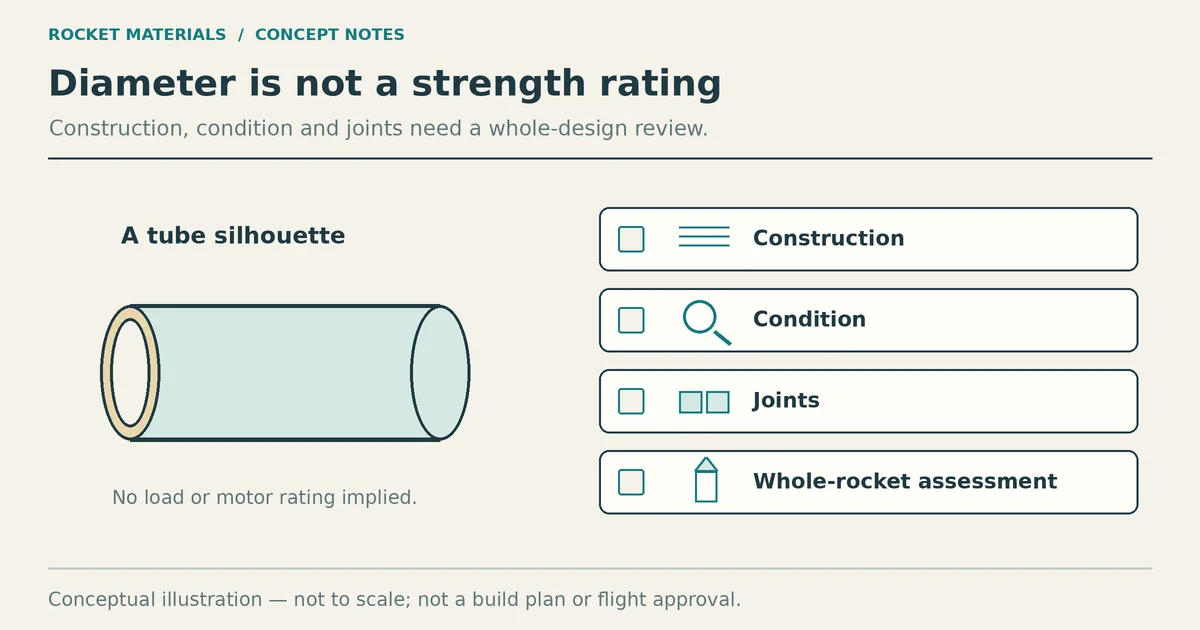
Wall thickness affects an opening and may affect mass or stiffness, but these listings do not supply a tested load limit for the completed rocket. Do not choose paper, phenolic, Blue Tube, or fiberglass solely from a motor-class letter. The mount, thrust path, retention, recovery, stability, motor and launch conditions need a whole-vehicle check. The NAR high-power safety code calls for certified motors, a stable rocket, and suitable recovery; it does not turn a wall number into a flight approval.[7]
Blue Tube is not waterproof. ARR says to keep it dry, roughen the surface, and apply coats of oil-based sanding sealer before painting. Its product description also says it is not phenolic. Don’t substitute the original draft’s “blue polymer skin” or “skip sealing” advice for the manufacturer’s care instructions.[6]
The quickest next step is to choose the exact airframe and mount you intend to use, then fill in the two-diameter calculation above. Do not transfer dimensions or motor-range shorthand from a generic material comparison to a specific product or completed rocket.
FAQ
Does a thicker wall always reduce the inside diameter?
Only if you hold the outside diameter constant. eRockets’ BT-50 and BTH-50 listings keep the same 0.950-in ID but increase the OD from 0.976 to 0.992 in. Check both dimensions on the product you are buying.[1]
Is a 38-mm Blue Tube the same as BT-60?
No interchangeability is implied by those labels. The Apogee-listed ARR 38-mm tube has 1.616-in OD and 1.504-in ID, while Apogee’s BT-60-size paper model 10141 has 1.637-in OD and 1.595-in ID. Order or cut mating parts against the actual product dimensions.[5][2]
Can I choose centering rings by the radial gap alone?
No. The calculation gives a useful cross-section estimate, but you still need the ring’s actual inner and outer diameters, material and assembly design. Test-fit the tubes and rings together before committing to adhesive.
Sources
[1] https://www.erockets.biz/body-tube-sizes/
[2] https://www.apogeerockets.com/Building_Supplies/Body_Tubes/Low_Power_Tubes/41mm_x_18_Body_Tube_Estes_BT-60_Size
[3] https://locprecision.com/products/cardboard-airframes
[4] https://www.apogeerockets.com/Building_Supplies/Body_Tubes/29mm_to_54mm_Tubes/29mm_x_34in_Thick_Wall_Tube
[5] https://www.apogeerockets.com/Building_Supplies/Body_Tubes/Blue_Tubes/38mm_Blue_Tube
[6] https://alwaysreadyrocketry.com/blue-tube-2-0/
[7] https://www.nar.org/HPRSafetyCode
[8] https://rocketmaterials.org/model-rocket-body-tube-size-chart-complete-compatibility-guide/
[9] https://www.apogeerockets.com/Building_Supplies/Body_Tubes/High_Power_Tubes/38mm_LOC_Body_Tube