

Model Rocket Tube Couplers: Dry-Fit and Joint Checks
Before bonding a tube coupler, answer two different questions: which exact part have you selected, and what does your kit say this joint is meant to do? A product listing can identify the part without telling you which surfaces to bond or where the finished rocket should separate.
Use the coupler’s identity, the applicable kit instructions and a record of your own dry-fit observations together. If the joint’s role or bonding instruction is missing, ask the maker before committing to adhesive. This guide helps you organize those checks; it does not supply a universal insertion depth, fit tolerance or assembly recipe.
Identify the coupler before interpreting its length
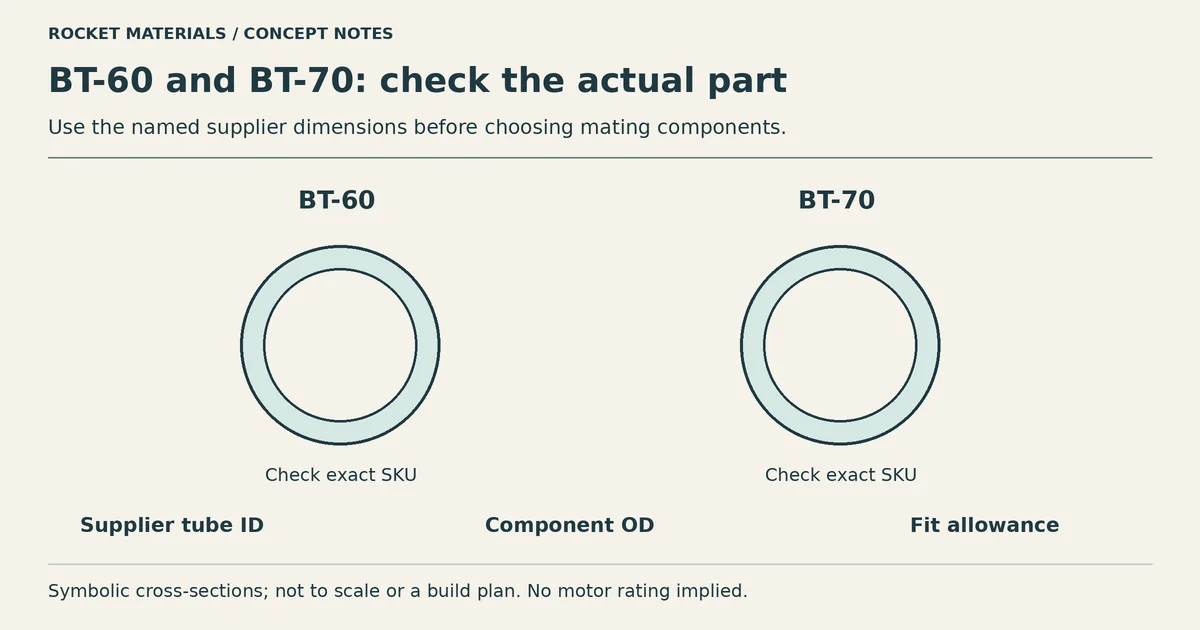
A concrete example is Estes BT55–BT60 Tube Couplers, SKU 003177. Estes lists two BT55 couplers measuring 1.25 inches long, plus four BT60 couplers: two measuring 1.5 inches and two measuring 3 inches. Those are listed pack contents and part lengths, not instructions to insert or bond a particular fraction of the coupler.
For your record, select the actual tube family and supplied length rather than writing only the pack name. Keep the listing separate from the kit manual: this Estes listing does not establish the joint role, insertion instruction or adhesive for your build. A listed family is not a completed physical fit check.
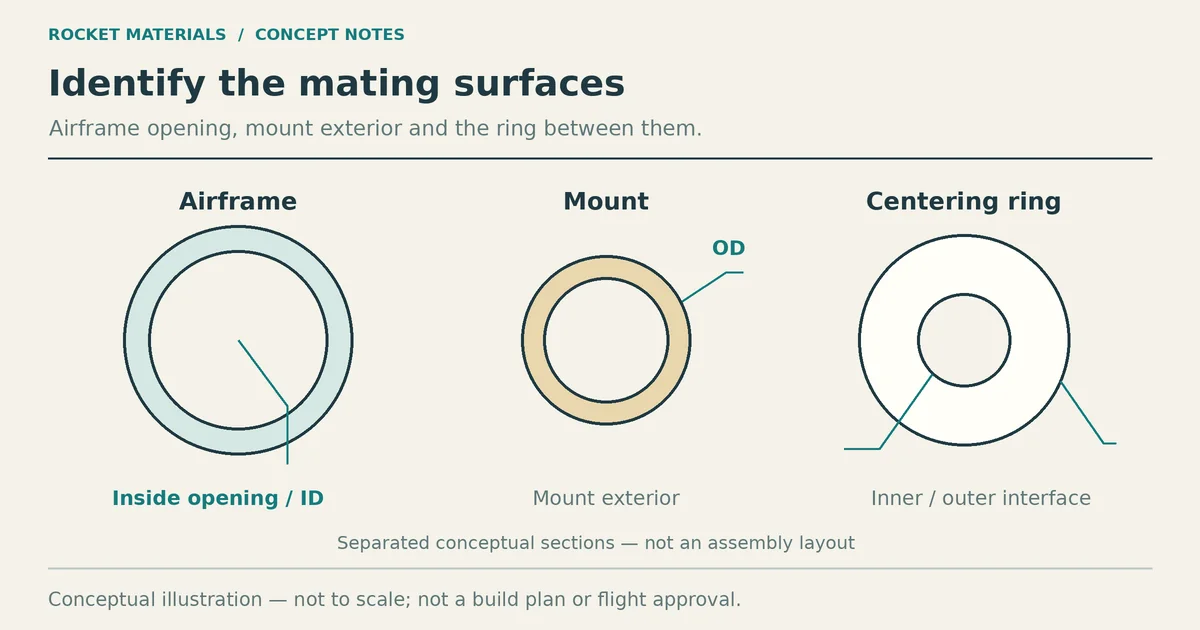
If your question is about nominal dimensions, use the paper body-tube dimensions and mating surfaces reference. For a mixed-diameter assembly, see the separate discussion of transitions versus same-size couplers. Neither replaces the instructions for the particular joint you are building.
Record one joint, not just one tube size
Copy this blank record into a document or print it and write in your answers. It does not save entries online. Use a separate record for each joint. These fields are an organizational aid, not manufacturer instructions.
Keep maker statements with their source references and your own observations with your name and date. Missing information stays unknown; a filled-in record is not bonding authorization or flight approval.
| Field | Your record |
|---|---|
| Kit and version | Not entered — maker, exact kit and version. |
| Coupler and mating sections | Not entered — maker, SKU, variant, supplied length and the exact sections at this joint. |
| Applicable instructions | Not entered — document title, URL or saved copy, revision, page or step and date consulted. Record an unstated revision as unstated. |
| Joint role | Unknown — record the manual’s statement about a permanent joint or intended separation point, with its reference. |
| Surfaces and sequence | Unknown — record only the applicable instructions for surfaces to bond, surfaces to leave separable and insertion or assembly sequence. |
| Space and obstruction questions | Not entered — record the applicable payload or recovery-path instruction and any question it leaves unresolved. |
| Conflicting or missing instructions | Not entered — retain each source separately rather than silently reconciling it. |
Keep dry-fit notes separate from specifications
Use these prompts alongside the exact kit’s instructions, not as a substitute procedure or a universal acceptance test. No measurements or observations have been completed here.
- Which exact parts and dry-fit instruction did you use?
- What did you observe about tube ends, alignment, damage or binding?
- If the manual supplies an insertion mark or sequence, which page or step applies?
- What remains unclear about available space, nearby components or intended separation movement?
- Your observation record
- Not entered — author, date, exact parts and notes.
- Question for the maker
- Not entered — identify the joint and missing or conflicting instruction.
- Response and remaining unknowns
- Not entered — keep the response, date and its stated applicability.
Questions to settle before adhesive
Read back the record before following the kit’s bonding sequence. These are editorial questions for checking whether you have the relevant information, not new construction instructions.
- Does the part identity match the exact joint and kit version you are working on?
- Can you point to the instruction defining the joint’s role, rather than infer it from a neat fit or a familiar label?
- Are the surfaces to bond and any surfaces to leave separable explicitly identified?
- Do your observations leave binding, damage, alignment or a possible obstruction unresolved?
- If two sources disagree, have you kept both and obtained a response applicable to these parts?
If a question is unresolved, pause the bonding decision and take the exact part identities, manual reference and observation notes to the maker. Do not turn the supplied coupler length into an insertion rule or use a guessed modification to fill a missing instruction.
Keep the record with the build
Retain the source and response with your joint notes so you can see what the decision was based on. If a part or kit version changes, revisit the record rather than assuming the previous answer still applies. The practical result is a traceable joint decision, not a certificate of fit, strength or flight readiness.
For the surrounding material and component questions, return to the body-tube materials and fit guides.

One Comment