Model rocket nose cone shapes: compare the trade-offs
A pointed nose looks fast. That does not tell you which nose belongs on your rocket. Model rocket nose cone shapes differ in how they meet the airflow, but the useful comparison also depends on nose length, diameter, finished mass and the speeds the rocket reaches.
For a kit, keep the specified nose unless the manufacturer approves a change. For a custom design, compare the actual candidates in a complete rocket model rather than picking a shape from a universal ranking. A rounded elliptical nose, a circular-arc ogive and a von Karman nose are different profiles, not steps on a ladder from beginner to advanced.
The table below helps identify them. The sections after it explain which trade-offs deserve attention before you order a replacement.
Model rocket nose cone shapes at a glance
| Shape | Side profile | Useful comparison point |
|---|---|---|
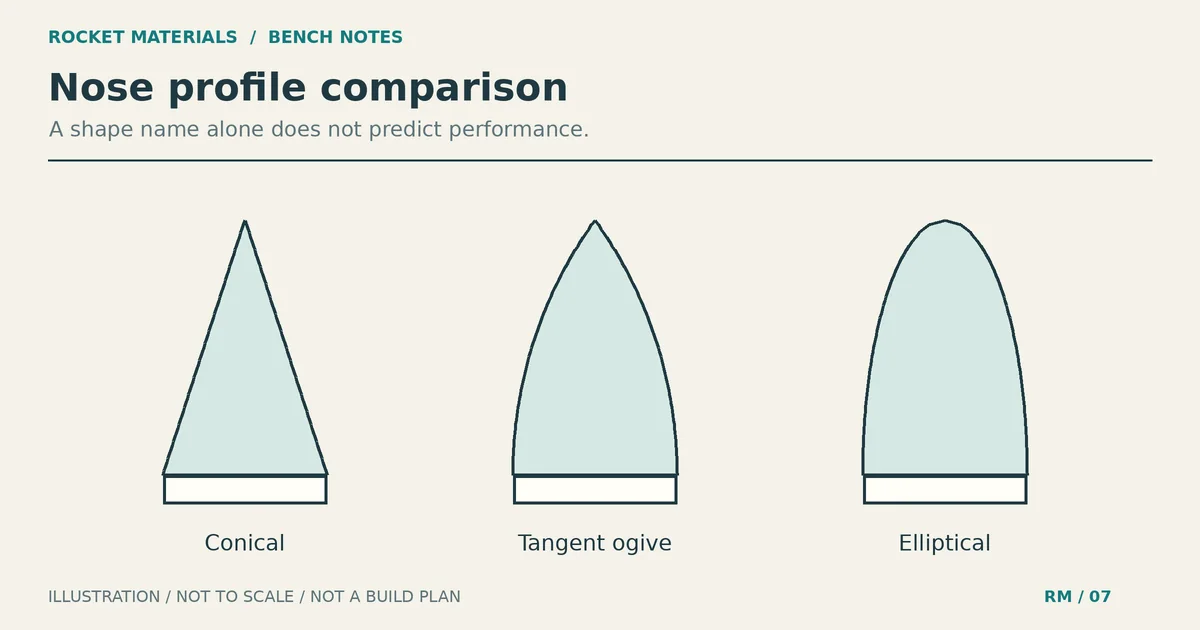
| Conical | Straight sides running from tip to base | A simple geometry; compare the base angle and nose length, not just the sharp tip. |
| Tangent ogive | Circular arc that meets the cylindrical body tangentially | A smooth change in slope at the base; it is not the same curve as a von Karman nose. |
| Secant ogive | Circular-arc profile with a different relationship to the base | Check the actual curve and junction; an ogive label alone is incomplete. |
| Elliptical | Rounded nose based on part of an ellipse | A candidate for comparison on a subsonic design, without assuming it wins every low-speed flight. |
| Parabolic series | Profile based on a section of a parabola | The series parameter changes the curve; two parabolic noses need not match. |
| Power series | Radius follows a power of distance from the tip | The exponent matters. This is a family, not one fixed silhouette. |
| Haack series, including von Karman | Mathematically defined curved profile | Designed around theoretical pressure-drag constraints; total flight performance still needs comparison. |
These definitions follow Appendix A of the OpenRocket technical documentation. The document dates to 2013; its geometry descriptions are useful references, not a claim about the menus in every current release.
How to tell similar profiles apart
Conical and ogive noses
A true cone has a straight outline in side view. Increasing its length at the same base diameter makes its sides shallower. A small rounded tip on a manufactured part does not make the rest of that straight profile an ogive.
An ogive uses a circular arc. On a tangent ogive, the curve joins the body with the same slope as the cylindrical tube. A secant ogive uses a different arc relationship and can meet the body at an angle. That distinction is easy to miss in a catalog photograph, especially when the nose is painted.
Ask for a dimensioned drawing or the manufacturer’s shape designation when the distinction affects your simulation. Guessing from a thumbnail can put the wrong geometry into an otherwise careful model.
Elliptical, parabolic and power-series noses
An elliptical nose has a rounded tip and an ellipse-based profile. Its length changes how stretched the shape looks. A hemisphere is a special case of this family, not a description of every elliptical rocket nose.
A parabolic-series nose uses a different curve. OpenRocket’s geometry reference distinguishes it from a paraboloid, so treating every rounded profile as “parabolic” loses information. Power-series noses add another family: changing the exponent changes how quickly the radius grows behind the tip.
For most builders, recognizing the families is enough. You do not need to derive the equations to buy a nose, but you do need more than the word “streamlined” to model it accurately.
Haack and von Karman noses
The Haack series comes from a mathematical treatment of pressure drag. The LD-Haack member, commonly called von Karman, addresses a specified length and diameter. The LV-Haack member uses length and volume constraints instead.
A commercial von Karman nose still needs to earn its place in your design. The theoretical pressure-drag result does not establish that it will send every rocket higher than an ogive. Total drag includes more than nose pressure drag, and the replacement may change mass as well.
Speed changes the aerodynamic comparison
Subsonic means below the local speed of sound; supersonic means above it. Transonic describes the region around it, where compressibility effects become especially important. A rocket can move through more than one of these regimes during a flight.
NASA’s drag equation explanation separates drag into the effects of air density, velocity squared, reference area and drag coefficient. The coefficient gathers complex effects that include shape and compressibility. That makes a single shape ranking, detached from speed and dimensions, a poor buying guide.
For a rocket that stays well below the speed of sound, do not assume a needle-like point gives a useful advantage. NASA’s water-rocket teaching material notes that a sharp point has no clear advantage at the fairly low speeds of that example. It also explains why shock waves change the issue near or above supersonic speed. This is a physical explanation, not a performance chart for motor-powered model rockets.
If your design approaches that region, compare drag across its expected speed range. OpenRocket’s Appendix B discusses transonic and supersonic nose-drag estimation and acknowledges gaps in the available data. Treat a simulated difference as a prediction with assumptions, not as a measured result.
A longer nose is not automatically better
Nose fineness ratio means the exposed nose length divided by its base diameter. The inserted shoulder is not part of that exposed aerodynamic length. Keep this definition consistent when comparing supplier specifications with a simulation.
Length changes the taper, but it also changes the surface exposed to airflow. NASA’s low-speed example warns that a very long nose can add skin-friction drag. In a real part, extra length may also change shell mass, usable internal space and how easily the tip gets damaged during transport.
There is no universal length-to-diameter ratio to prescribe here. Compare lengths that are available and appropriate for your design. A ratio quoted for one speed regime or one pressure-drag study does not settle the finished rocket’s altitude.
Keep diameter in view, too. Noses with different base diameters are not a controlled shape comparison. Use the published body tube size chart as a starting reference for the airframe family, then confirm the actual supplier dimensions. Detailed shoulder fitting is a separate task.
Mass and stability can outweigh a small drag difference
A nose change can move the center of gravity, the rocket’s balance point. It can also change the predicted center of pressure because the external geometry has changed. Both belong in the stability review.
The Estes Model Rocketry Technical Manual explains the balance point and the opposing aerodynamic effects of the nose and fins. Its finishing section also notes that a smooth finish reduces drag. Neither point supports choosing by nose shape alone.
Weigh the finished nose assembly with the hardware that will fly. Do not compare a bare shell against a nose with its attachment and ballast installed. A heavier replacement is not an automatic altitude penalty of a fixed amount, nor is more forward mass a substitute for evaluating the whole design.
The same measurement discipline applies elsewhere on the rocket. Our guide to comparing actual body tube weights explains why dimensions and construction belong beside material names. For a nose comparison, record the mass of each specific candidate rather than assigning one weight to an entire shape family.
Compare geometry first, then compare the parts you can buy
Two separate comparisons answer two useful questions. The first isolates the shape. The second checks whether a particular replacement makes sense on the finished rocket.
- Start with a model that represents the existing rocket. Use the intended commercial motor and the same launch conditions in each comparison.
- For a geometry-only comparison, keep nose length and base diameter fixed. Hold the rocket’s mass and mass distribution constant using appropriate overrides, and change only the nose profile. Label this an artificial comparison, not a build specification.
- For the actual-part comparison, enter each candidate’s real exposed length, diameter and finished assembly mass. Update its mass position and the rest of the assembled model as needed.
- Review predicted speed, apogee and stability behavior, along with simulation warnings. Recheck recovery suitability after a mass change rather than stopping at the altitude result.
Write down what changed between the files. If one run has a longer, heavier nose and another has a shorter, lighter one, the altitude difference cannot honestly be credited to shape alone. Small predicted gains also deserve caution when the profile or finish is only an approximation.
Before chasing that gain, inspect the rest of the airframe. The fin alignment and inspection guide covers workmanship checks that remain relevant whichever nose you choose. A simulation does not correct a crooked fin or damaged joint.
Choose a nose for the complete rocket
For a first kit, the supplied nose keeps the build aligned with the instructions. For a scale model, matching the prototype’s outline can be a legitimate priority. For a custom performance design, compare suitable commercial parts at the expected speeds and include their measured mass.
Before flying a modified rocket, confirm that its recovery system and attachments remain appropriate, review the complete design and follow current manufacturer directions and the applicable safety code. Do not sharpen a nose or add unapproved hardware just to imitate a drawing.
Start your shortlist with the correct airframe diameter and an identifiable profile. Then record each candidate’s exposed length and finished mass. Those details give you a useful comparison; the shape name by itself does not.