Model rocket rail buttons: fit and mounting checks
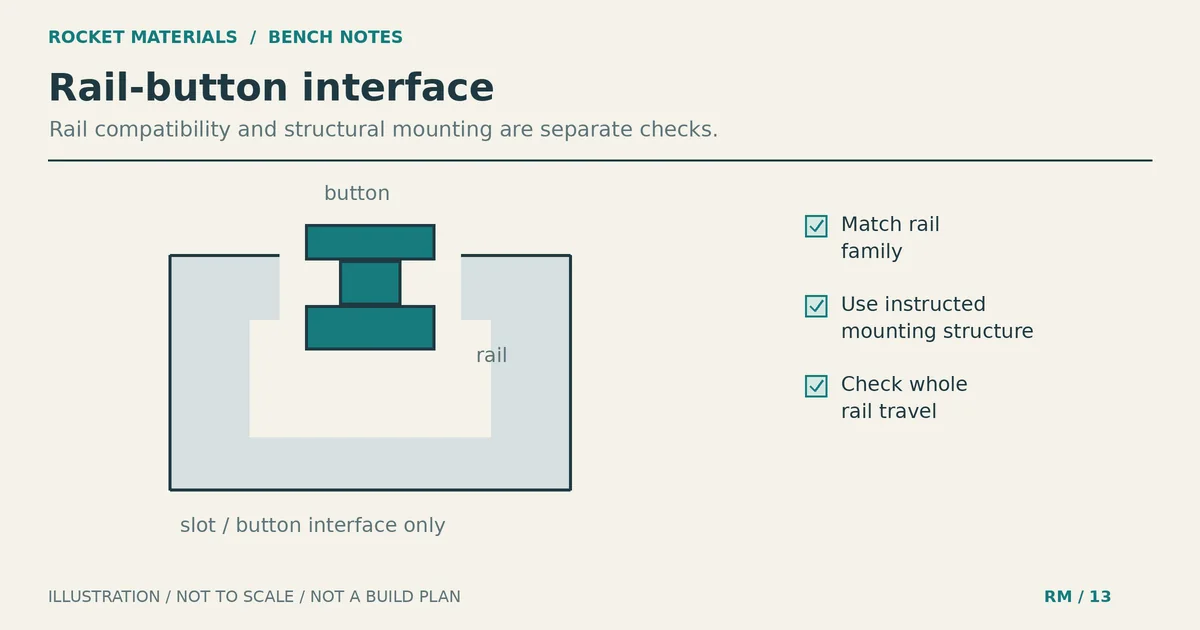
A rail designation and a mounting instruction answer different questions. Identify the exact guide or button and its declared launcher interface first; then find the instructions that apply to attaching that hardware to your particular rocket. Do not treat a shared rail label as permission to copy another kit’s mounting arrangement.
This guide contrasts a documented screw-mounted kit system with a documented glue-on product. It also gives you a compact record for the actual kit, hardware and available rail. The examples establish their own source-listed identities, not compatibility with every rocket or a completed launch assessment.
Rail buttons and glue-on guides: read beyond the name
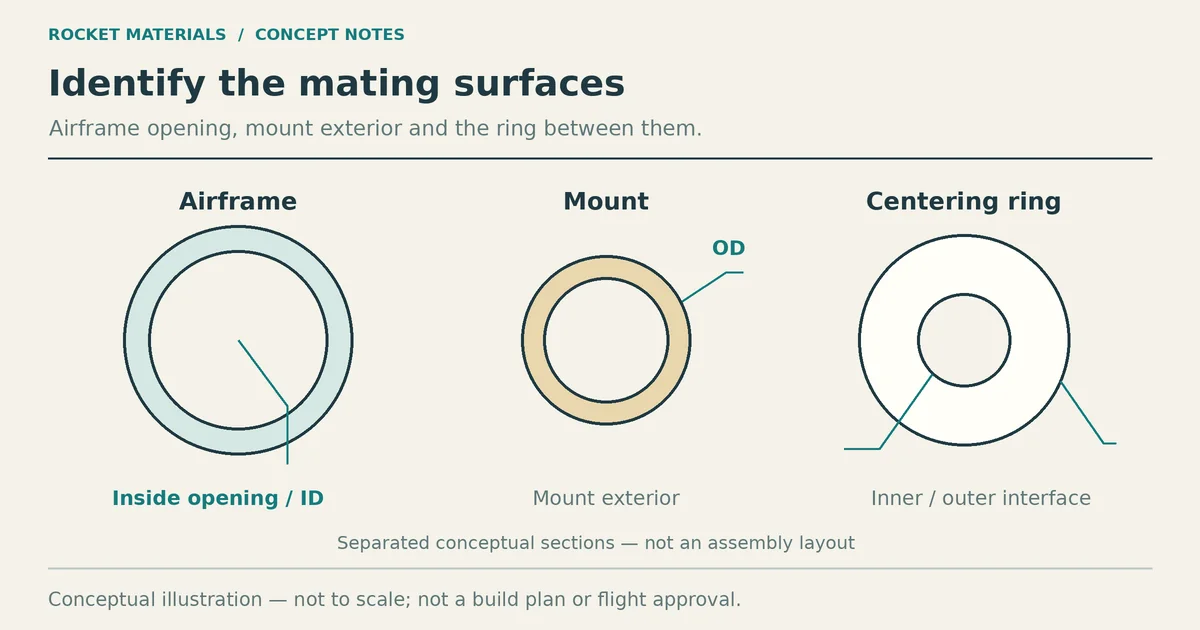
The official LOC Cyclotron product page identifies a 1010-series rail-guide interface for the 3-inch Cyclotron PK-47. Its linked Cyclotron instructions list 1010 rail guides with screws and also call them rail buttons. The manual names the forward and middle centering rings as the anchors. That is a kit-specific attachment identity, not a general instruction to put a screw into an airframe.
The linked manual text names both 3-inch and 4-inch Cyclotron kits. Match the actual kit to its applicable instructions; the PK-47 identity above belongs to the 3-inch product page. The filename contains rev2, but that alone does not verify a printed revision. The ring-anchor example here does not reproduce a drilling, spacing, spacer or fin-placement recipe.
For a different mounting interface, Apogee Universal Rail Guides, model 13531, are listed by their maker as urethane-resin guides for standard 1010 launch rails, glued to the outside of the tube. Despite the product name, this listing is not a guarantee for every rocket, rail or load. Its glue-on arrangement is not an installation method for LOC’s screw-mounted buttons.
| Named system and source | What the source establishes |
|---|---|
| LOC 3-inch Cyclotron PK-47 and linked manual | 1010 guides/buttons with screws; manual-defined centering-ring anchors for that kit system. Not a transferable mounting recipe. |
| Apogee model 13531 | Maker-listed standard-1010, urethane-resin, glue-on guide. Not a screw-button recipe or universal suitability claim. |
Preparation and travel checks belong to the named product
Apogee’s model 13531 instructions on the product page describe removing slippery mold release with soap and water. The same page calls for checking the launch-rail slots so the rocket still slides easily after painting. Those are source-reported checks for this guide, not a universal surface-preparation method, adhesive specification or proof that an assembled rocket is ready to fly.
For the screw-mounted kit example, keep the relevant mounting instructions with the parts record instead of borrowing preparation advice from the glue-on example. If the exact hardware, supporting structure or applicable instruction is unclear, resolve that question with the maker before modifying the rocket. The adhesive and assembly guides can help organize surrounding joint questions, but do not establish the rail-button installation for your kit.
Record the kit, guide and actual launcher
Copy or print this blank record; it does not save entries online. These are original organizing fields, not an installation procedure. Keep a maker’s declared interface separate from your own observations and an organizer’s reply.
| Field | Your record |
|---|---|
| Kit and hardware identity | Not entered — exact kit/version, guide maker, product/SKU and variant. |
| Declared launcher interface | Unknown — record the exact product statement and source; do not infer it from the rocket. |
| Available launcher | Not entered — actual rail identity/profile and organizer confirmation, with source and date. |
| Applicable mounting instructions | Unknown — document title, URL or saved copy, revision, page/step and date consulted; record an unstated revision as unstated. |
| Attachment and clearance questions | Not entered — source-defined mounting arrangement, any clearance instruction, and unresolved internal or external obstruction questions. |
| Your observations | Not entered — author/date, exact unpowered hardware, applicable instruction and any observed binding or coating interference. |
| Question and response | Not entered — missing or conflicting specification, maker/organizer response, date and remaining unknowns. |
Use a separate record when the kit, guide or available launcher changes. An organizer’s hardware confirmation is not a maker specification; your observation is not an independent product test. Unknown compatibility remains unknown.
Before buying or changing the mounting arrangement
- Can you identify both the exact hardware and its source-declared rail interface?
- Has the launch organizer identified the available launcher, rather than simply confirmed that the site has a rail?
- Do you have mounting instructions applicable to the actual kit and guide, not just a different product using the same rail label?
- Does the record leave a coating, binding, attachment or obstruction question unresolved?
If an observation reveals binding or the instructions leave the mounting arrangement uncertain, pause and ask the maker about the exact configuration. Record the response rather than infer a spacer, changed fastener or altered guide profile. These questions are a way to find missing evidence, not a remote diagnosis or a clearance test.
Keep fit separate from launch approval
A listed 1010 interface, documented attachment identity or recorded travel observation does not settle flight readiness. This guide provides no motor or mass cutoff, guide-spacing rule, launcher-length prescription or installation dimensions. Keep the applicable kit/product instructions and the launch site’s assessment separate from this hardware record.
The useful next step is to bring a specific question: name the kit, guide, launcher and source reference, then explain what remains unresolved. That gives the maker or launch organizer something concrete to answer without treating a familiar product label as approval.