CA Glue vs Wood Glue for Model Rockets: Choose by Joint
For a typical balsa-fin and cardboard-tube model rocket, start with wood glue for well-fitting wood-to-paper and paper-to-paper joints. CA (cyanoacrylate) is useful when a compatible part needs a fast, localized bond or when you need to harden a porous edge; it is not a universal structural shortcut. Check the kit instructions and the actual materials before selecting either adhesive. Estes distinguishes porous balsa/paper bonds from plastic-part bonds, and Apogee cautions that CA can be brittle in structural use.[1][7]
CA Glue vs Wood Glue: Quick Decision Table
| Joint or task | Sensible starting point | Check before bonding |
|---|---|---|
| Balsa fin root to bare paper body tube | Wood glue; align and support until it holds | Expose sound paper, dry-fit the root, then add the kit-specified fillet.[1][2] |
| Paper coupler or cardboard centering ring in a paper tube | Wood glue if the kit specifies it | Test the fit and application sequence; avoid a pool of glue that can seize a sliding part.[1][7] |
| Balsa fin edge or small porous detail | Thin CA may be useful for local hardening or a close-fitting bond | Keep it out of the recovery path and off skin; do not equate quick handling with flight readiness.[7] |
| Plastic nose-cone pieces | Adhesive specified for that plastic, often plastic cement | Wood glue is not suitable for bonding plastic nose-cone parts.[1] |
| Motor mount, through-the-wall fin, composite or mixed-material structural joint | Use the kit or component maker’s specified adhesive and joint design | Neither CA nor wood glue is safe to prescribe from motor letter alone. |
| Nose cone that must separate to deploy recovery | No glue between cone/shoulder and airframe | It must separate as designed; distinguish attaching an insert inside the cone from bonding the cone to the tube.[4] |
Why the substrates matter more than the glue label
Wood glue is a practical choice where porous surfaces meet: balsa fin roots, bare paper tubes, and other wood/paper joints. Estes says carpenter’s glue works for balsa and paper but not for bonding plastic nose-cone parts; its plastic recommendation is plastic cement. Some CA formulations bond porous and nonporous materials, but compatibility with a particular plastic and joint still needs checking.[1] Titebond Original describes its intended use as wood and other porous materials and calls for enough pressure to bring mating surfaces tightly together; its maple-test strength figure is not a fin-to-cardboard strength rating.[6]
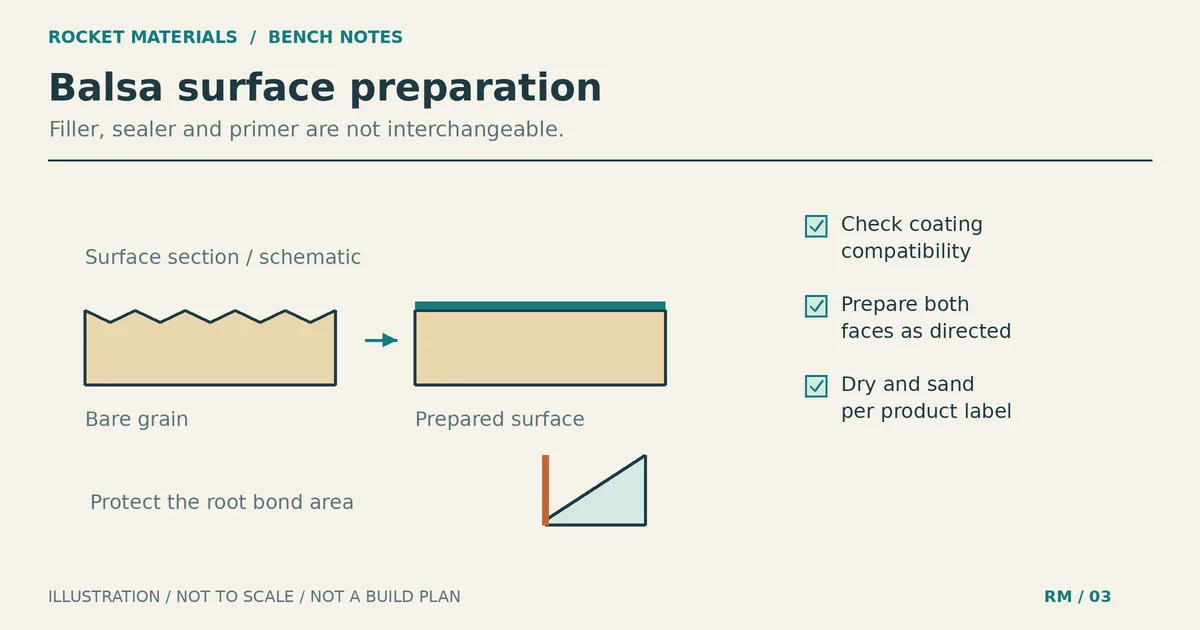
For a surface-mounted balsa fin, dry-fit the root against bare tube paper, remove finish or dust where the kit tells you to, apply a thin wood-glue layer, and hold the fin aligned while it takes hold. Apogee demonstrates a wood-glue double-glue joint—an initial thin coat on the fin root, followed by a second coat and attachment—and an external fillet after the fins are attached.[2] A jig or other support helps preserve the kit-specified alignment; this is not a claim that every wood-glue joint needs a prescribed clamp duration.
A fillet is not automatically a job for thick CA. Apogee discusses wood glue as a structural fillet on wood/paper rockets and notes that adding excess adhesive also adds aft mass.[3] Follow the kit’s specified fillet geometry and allow the adhesive to dry under its label conditions before flight. Avoid using surface appearance alone as proof of a sound root bond.
When CA helps—and when to stop
CA sets quickly and can be convenient for a small, close-fitting, compatible detail. Apogee lists fin skinning and body wraps among its uses, while warning that it bonds skin instantly and may be brittle for structural joints.[7] Do not pour thin CA into a fin slot as a blanket substitute for a designed through-the-wall attachment; do not choose thick CA for motor-mount retention, launch hardware or shock-cord anchors just because it sets fast. For load-bearing, mixed-material, heat-exposed or larger builds, follow the particular kit, motor-mount and adhesive instructions and review the complete structure rather than inferring capacity from a motor class.
Keep fingers clear of the bond, protect eyes, ventilate the work area, and consult the product label and safety data sheet. Keep CA off cotton clothing and cotton applicators: contact can generate heat and cause burns.[8] Accelerator is not a universal strength upgrade: use only as directed for the specific CA, and do not assume an accelerated joint has a published percentage change in strength. BSI advises against repeatedly refrigerating opened, frequently used CA bottles because condensation can enter; follow the label’s storage instructions rather than assuming freezer storage extends their life.[5]
Recovery components: a critical distinction
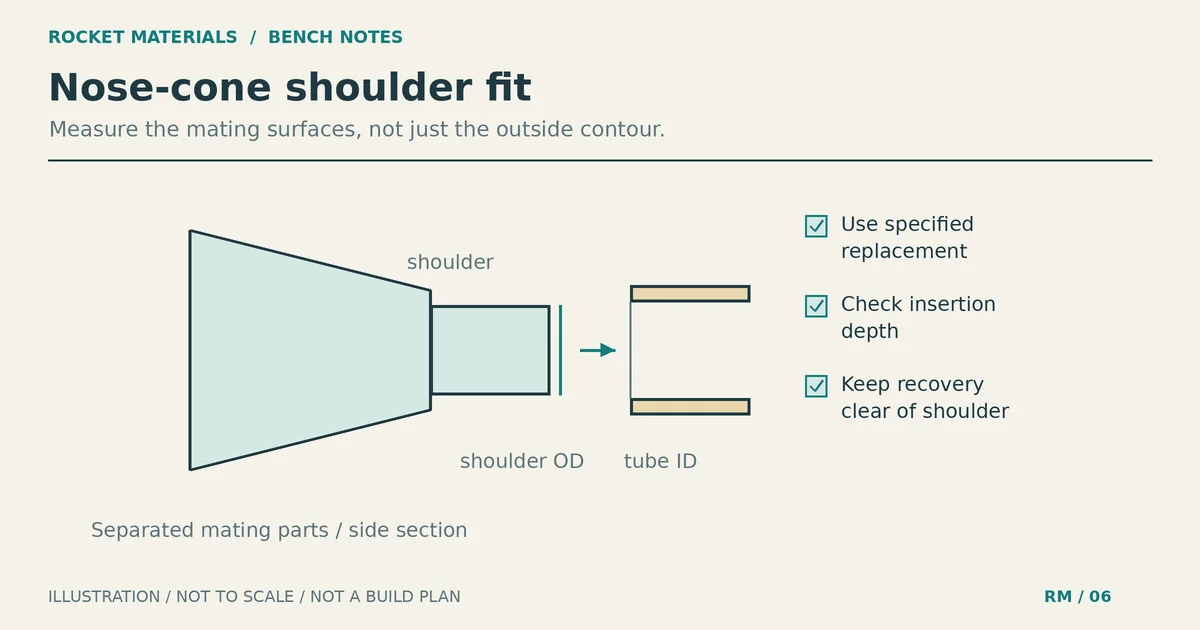
Some nose-cone kits require bonding two nose-cone parts to each other. That is different from gluing the removable nose-cone shoulder into the body tube. If that cone is the designed ejection opening, bonding it to the airframe can block parachute or streamer deployment. Do not glue or seal that separation joint. Dry-fit and secure the cone only as the specific recovery design instructs, then verify that the system can deploy before flight. The NAR Model Rocket Safety Code requires an effective recovery system; it does not endorse any specific adhesive for a nose cone.[4]
The same distinction applies to a shock-cord anchor: it is a load path, not a cosmetic spot bond. Use the attachment method, adhesive, material and curing conditions in the kit or recovery-system instructions. The recovery wadding guide covers protecting the recovery system; it does not size or validate the anchor.
Common questions
Can I use both glues on one rocket?
Yes, on different joints when each is compatible with its substrate. Do not add a CA fillet over wet wood glue and assume it has cured the hidden primary bond. Let each joint reach its manufacturer-specified cure condition before stressing it.[2][7]
Is one glue stronger or lighter?
Not in a transferable single number. Published wood-glue tests can use hard maple under specified conditions; a balsa-to-paper fin root has different substrates, area, surface preparation and loading.[6] Dispensed and retained glue also varies by builder and joint. The original draft’s per-fin mass, shear, price and cure comparisons had no matching test method, so this guide does not rank adhesives by those numbers. For the separate weight question, see the existing adhesive weight comparison—treat any figures there as design-specific until verified.
Should I use wood glue on a plastic nose cone?
Not for bonding plastic pieces: Estes recommends plastic cement for those assemblies and notes that carpenter’s glue is intended for balsa/paper parts.[1] But no adhesive should bridge a nose cone to the airframe if that interface must open for recovery.[4]
Before launch
Inspect fin and mount joints, follow all kit and adhesive instructions, and confirm that the nose cone and recovery system operate as designed. If a structural joint is loose or the cone cannot separate, repair the assembly before flying. Glue selection is part of a sound build, not a substitute for checking the complete rocket.[4]
Plastic substrates require their own adhesive-compatibility checks.[1]
Sources
[1] https://help.estesrockets.com/article/51-what-types-of-glues-will-work-best-to-build-model-rockets — Estes glue FAQ
[2] https://www.apogeerockets.com/Advanced_Construction_Videos/Rocketry_Video_190 — Apogee balsa fin attachment
[3] https://www.apogeerockets.com/Peak-of-Flight/Newsletter514 — Apogee fin fillets
[4] https://www.nar.org/ModelRocketSafetyCode — NAR model rocket safety code
[5] https://bsi-inc.com/hobby/ask_glue_pros.html — BSI glue FAQ
[6] https://www.titebond.com/print/product/d4d28015-603f-4dfc-a7d9-f684acc71207 — Titebond Original wood glue
[7] https://www.apogeerockets.com/Peak-of-Flight/Newsletter588 — Apogee adhesive selection
[8] https://pmc.ncbi.nlm.nih.gov/articles/PMC7335472/ — Cyanoacrylate and cotton burn case report